


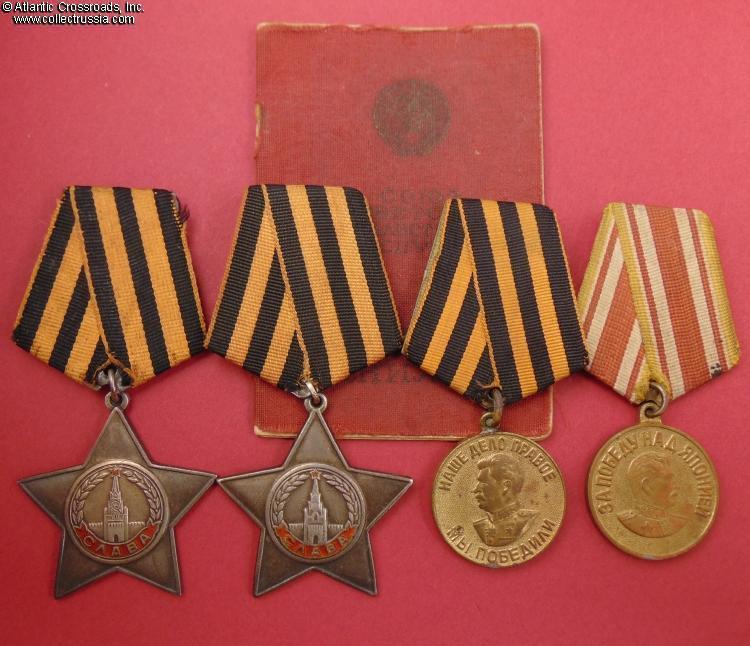
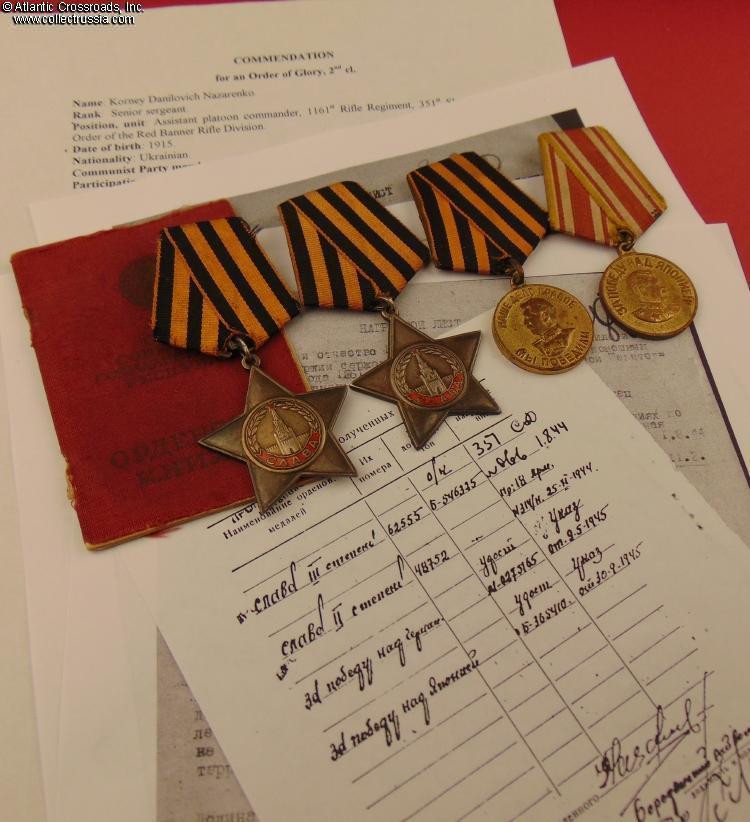
Documented Group of Four Decorations to Senior Sergeant Korney Nazarenko (Корней Данилович Назаренко), Deputy Platoon Commander, 1161st Rifle Regiment, 351st Rifle Division, 18th Army, 1st Ukrainian Front.
Decorations:
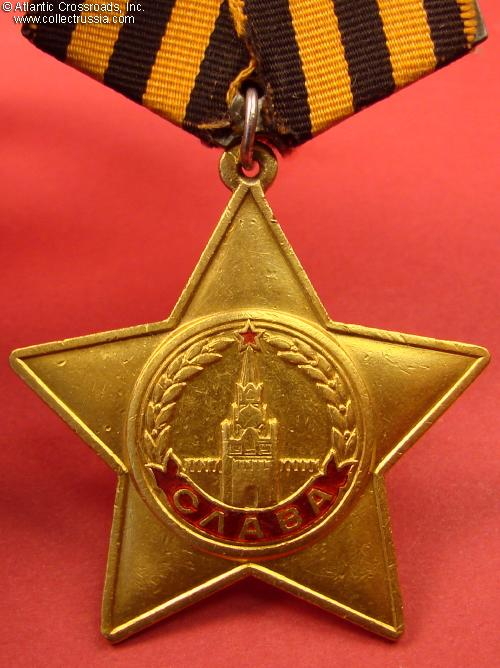
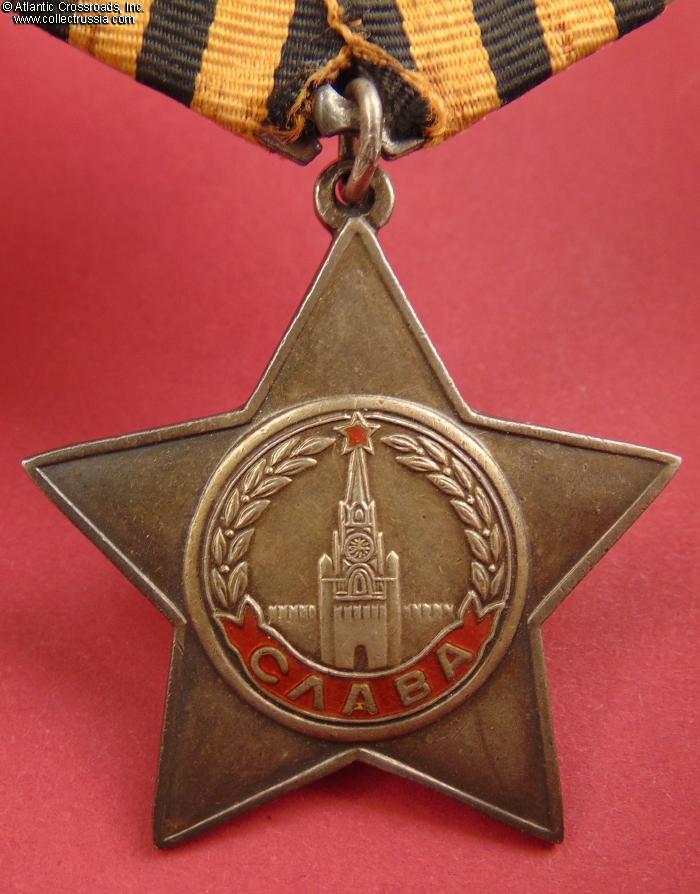
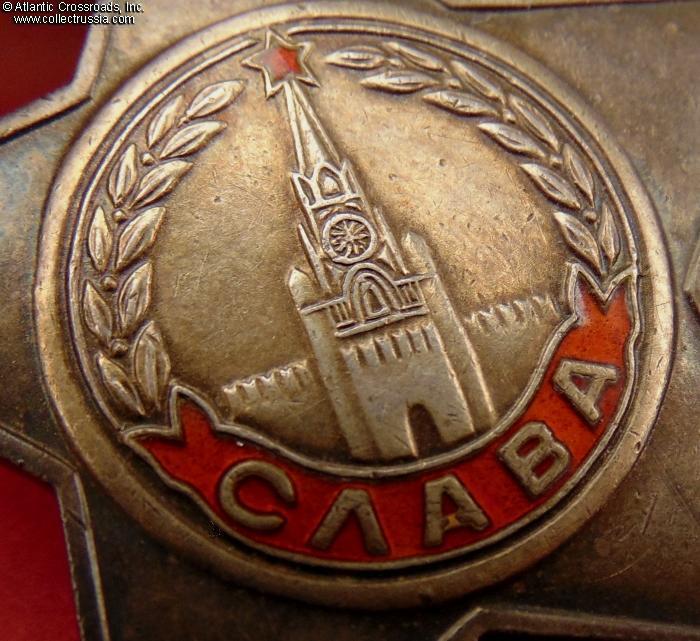
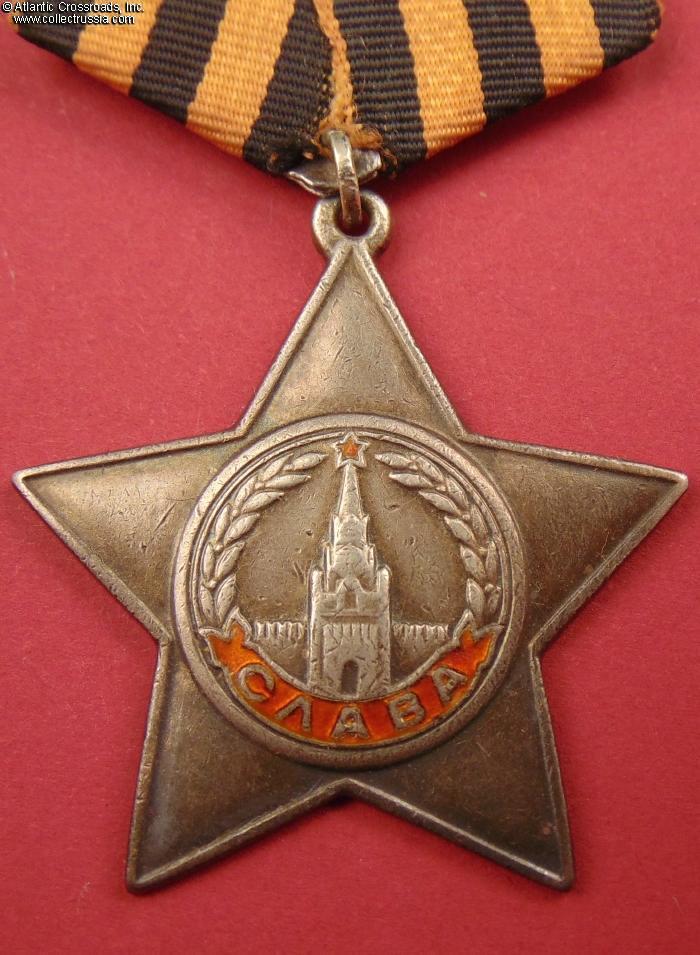
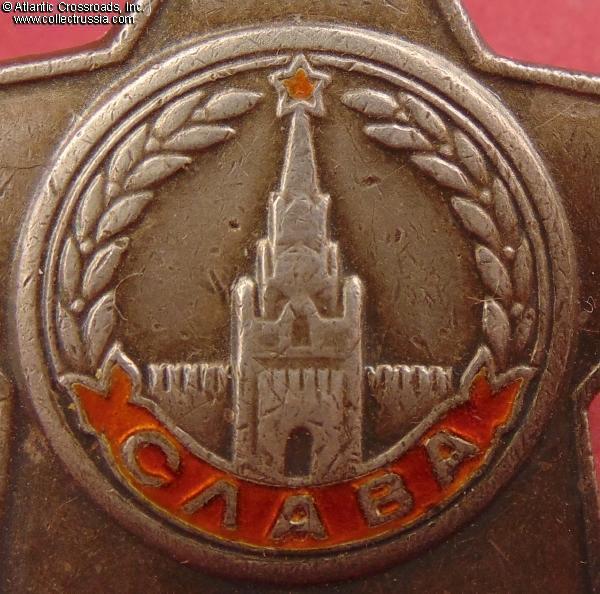
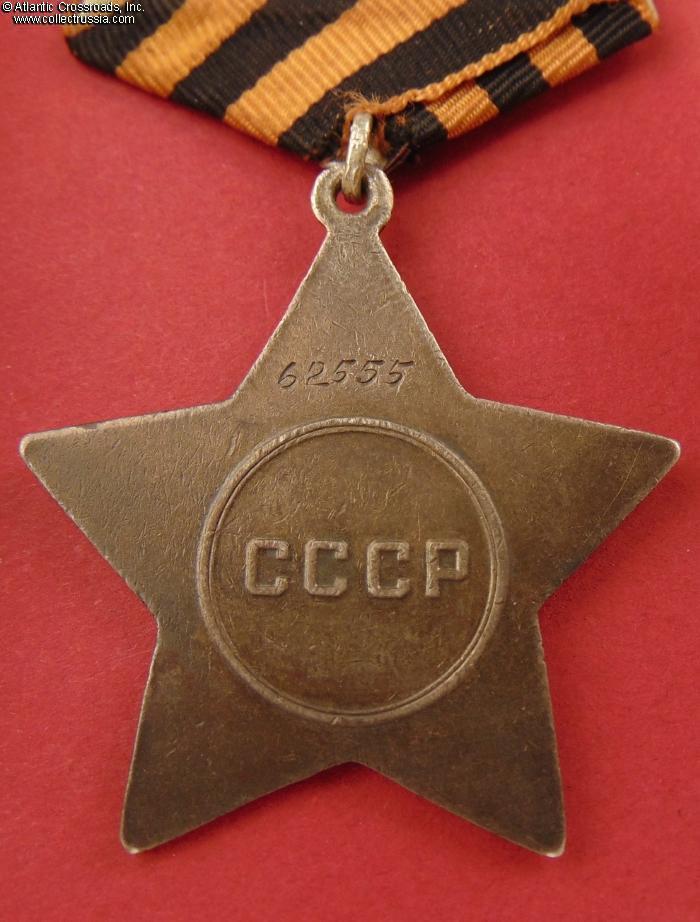
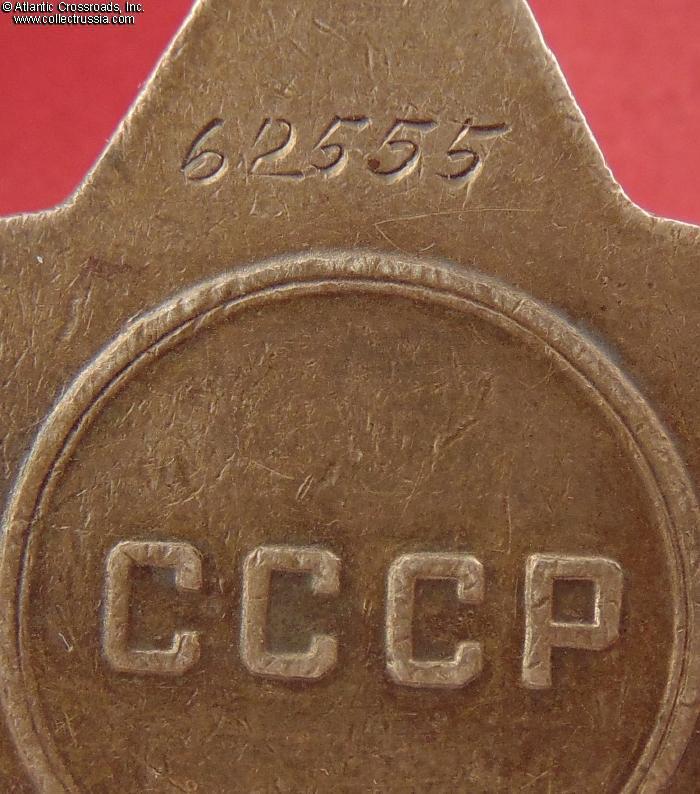
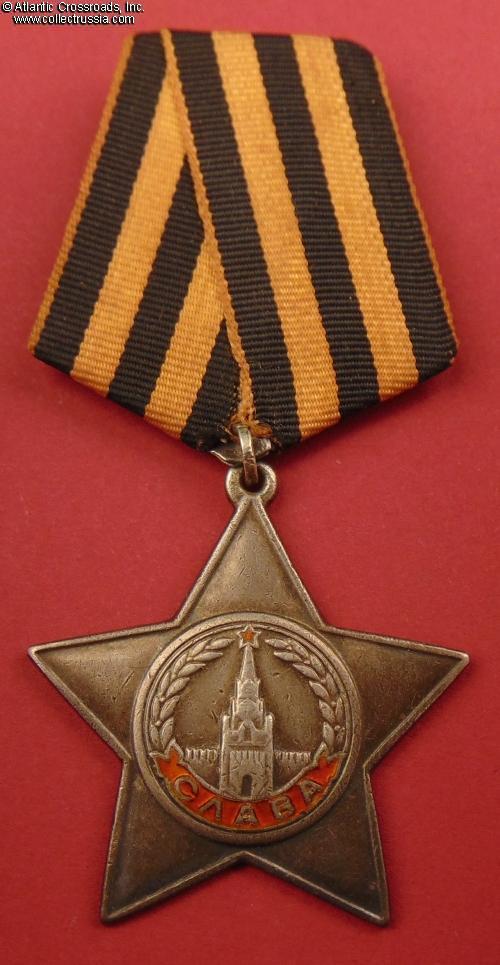
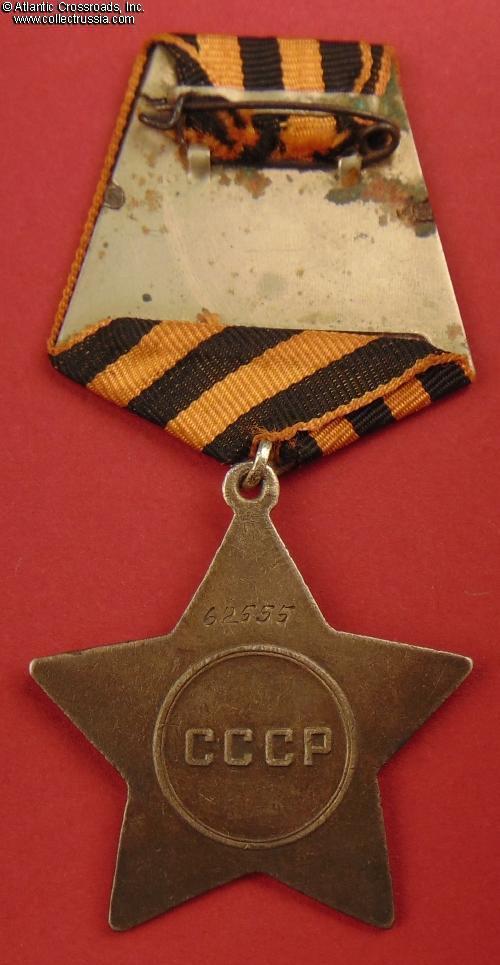
Order of Glory 3rd cl. #62555. Silver, enamel; measures 48.4 mm in height (incl. eyelet), 46.2 mm in width. Note the very low, five- digit serial number. Features early version of the medallion with the Kremlin tower touching the edge of the red scroll, arch under the clock without the horizontal bar in its upper portion, and the "windows" on the left and right of the arch having small vertical lines not reaching the bottom of the windows.
In very fine to excellent condition, far better than most wartime issues of the Order of Glory and espec
Decorations:
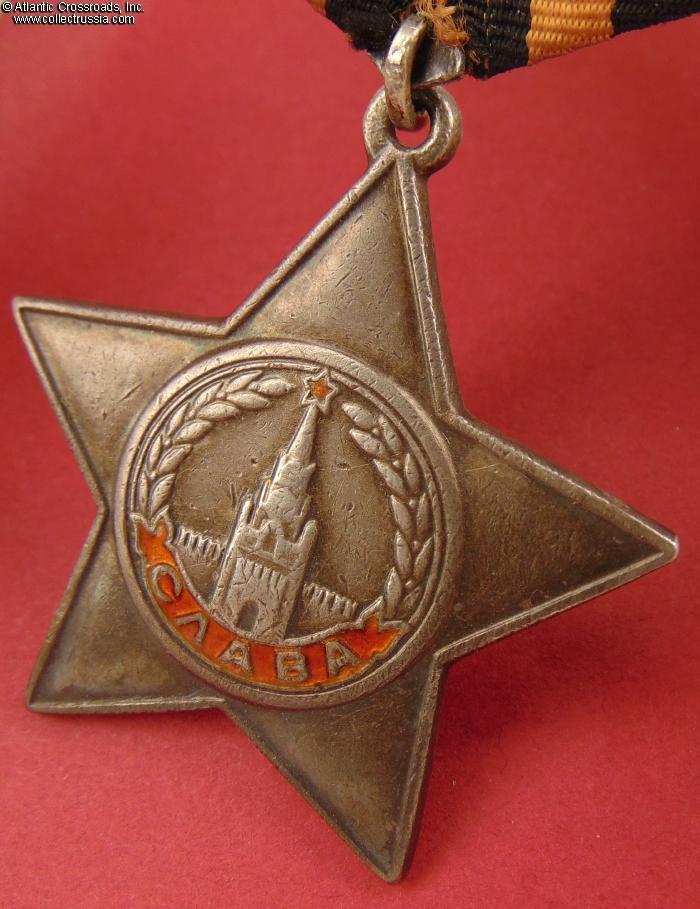
Order of Glory 3rd cl. #62555. Silver, enamel; measures 48.4 mm in height (incl. eyelet), 46.2 mm in width. Note the very low, five- digit serial number. Features early version of the medallion with the Kremlin tower touching the edge of the red scroll, arch under the clock without the horizontal bar in its upper portion, and the "windows" on the left and right of the arch having small vertical lines not reaching the bottom of the windows.
In very fine to excellent condition, far better than most wartime issues of the Order of Glory and especially very early ones. The red enamel on the scroll and star retains a nice luster and shows only some microscopic surface flakes and contact marks unnoticeable without magnification. There are miniscule dings and scratches to the center medallion and moderate wear to its high points, but the raised details remain relatively well-defined. The raised edge is completely free of bumps or knocks. Both the obverse and reverse show a very attractive dark patina to silver.
Comes on an original WW2 era suspension device, a two-layer model in steel with a self-locking pin. The perfectly preserved ribbon, although not original to the order, shows age and use. The connecting link is a replacement. To reiterate, this example is extremely well-preserved for an early issue.
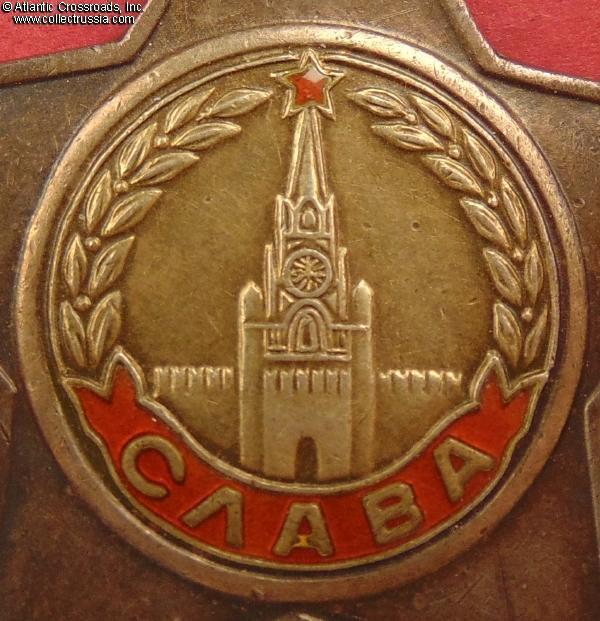
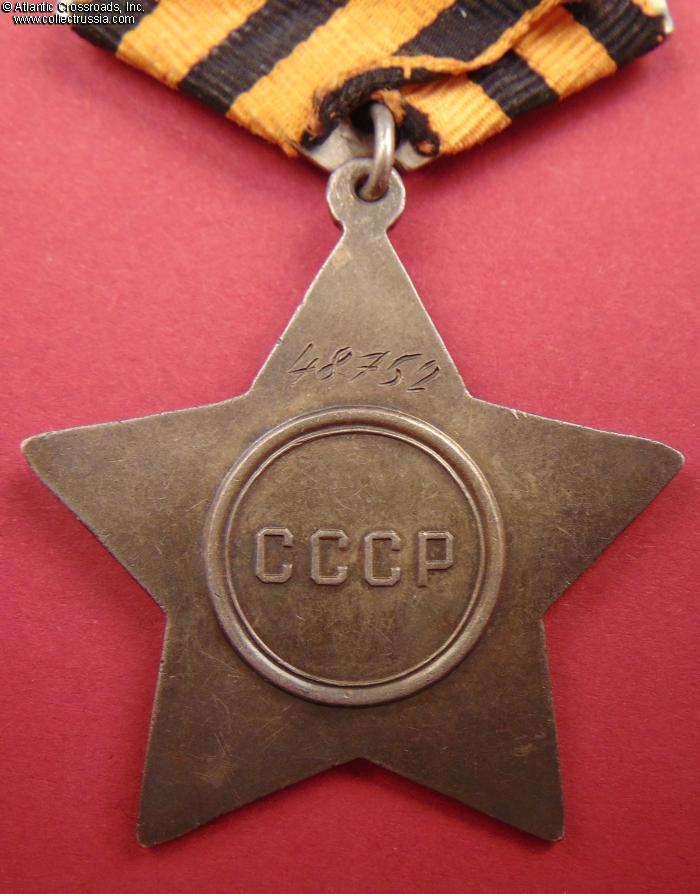
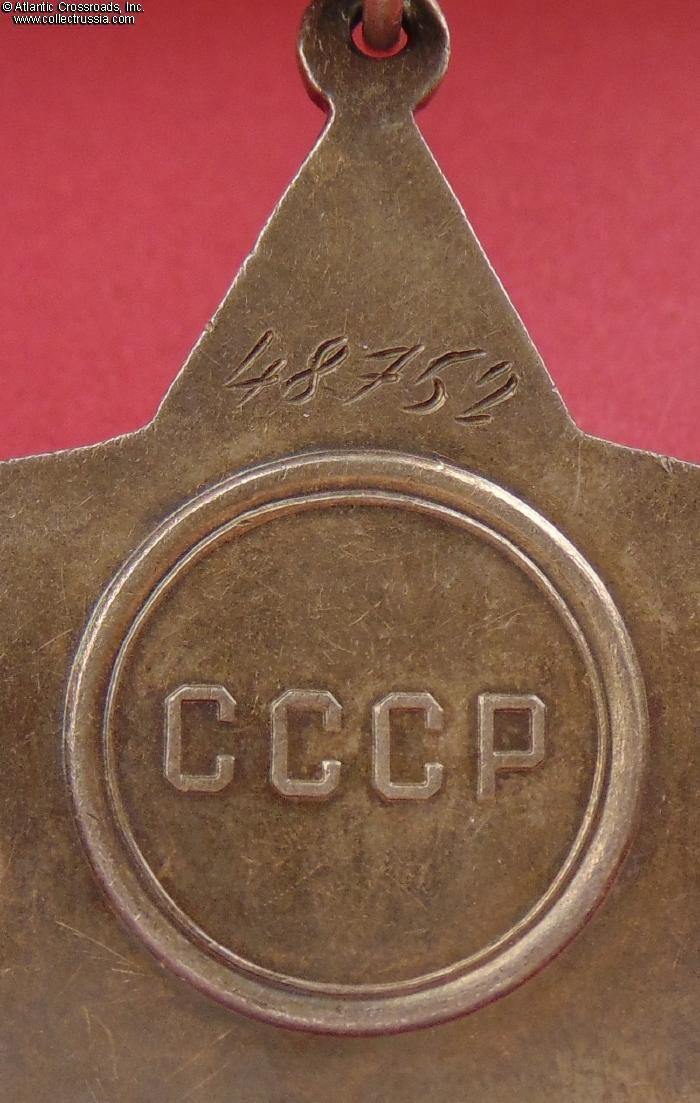
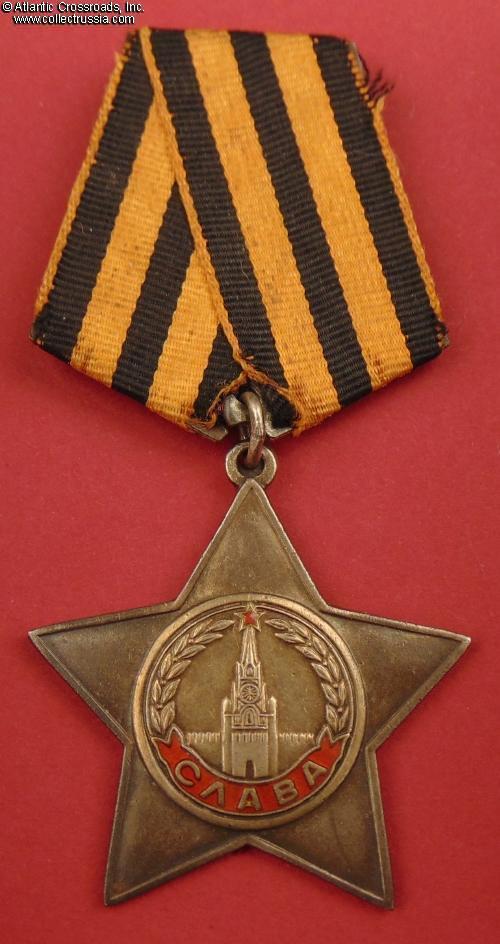
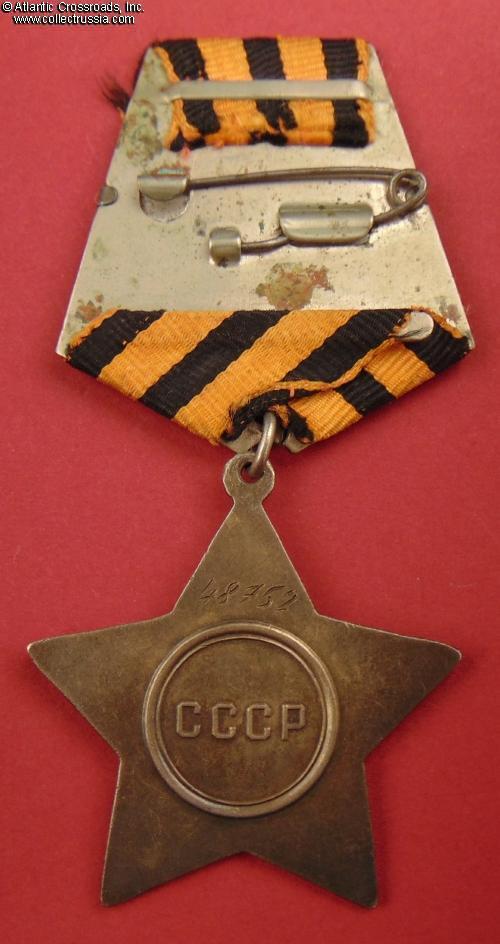
Order of Glory 2nd cl. #48752. Silver gilt, enamels. Measures 48.4 mm in height incl. eyelet, 46.3 mm in width; weighs 22.8 g not including the suspension and connecting link. This is the last version of the Order of Glory 2nd cl., featuring simplified, so-called "orange" ("apelsin") style of the clock with long dashes rather than numerals and thus resembling a slice of orange. Note an extremely high serial number, among the highest for the Glory, 2nd cl. (the highest currently known serial number for this class of the order is 49395).
In outstanding, excellent condition. The enamel is essentially perfect; it exhibits a nice luster, shows no wear visible to the naked eye, and has only a few microscopic contact marks that are hard to find even with a 10x loupe. The raised artwork is literally pristine and exceptionally crisp. The gold plating is extremely well-preserved, while the arms and reverse exhibit a beautiful patina to silver.
Comes on an original suspension device, a two-layer model in steel with an integral catch of the pin. The nicely preserved ribbon is old, likely original to the order. The connecting link appears to be original as well, and its ends are still joined with solder. To summarize, this is not only a very interesting piece numismatically due to its serial number, but also an extraordinarily well-preserved example - practically impossible to upgrade condition-wise.
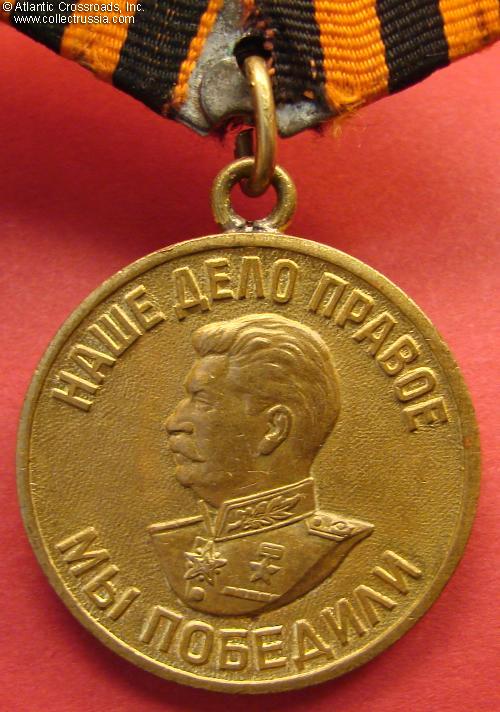
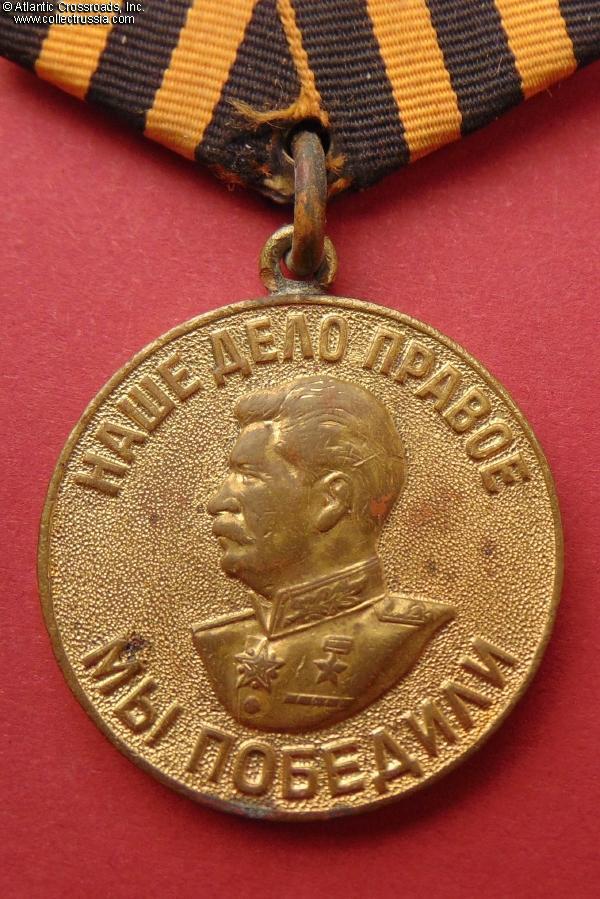
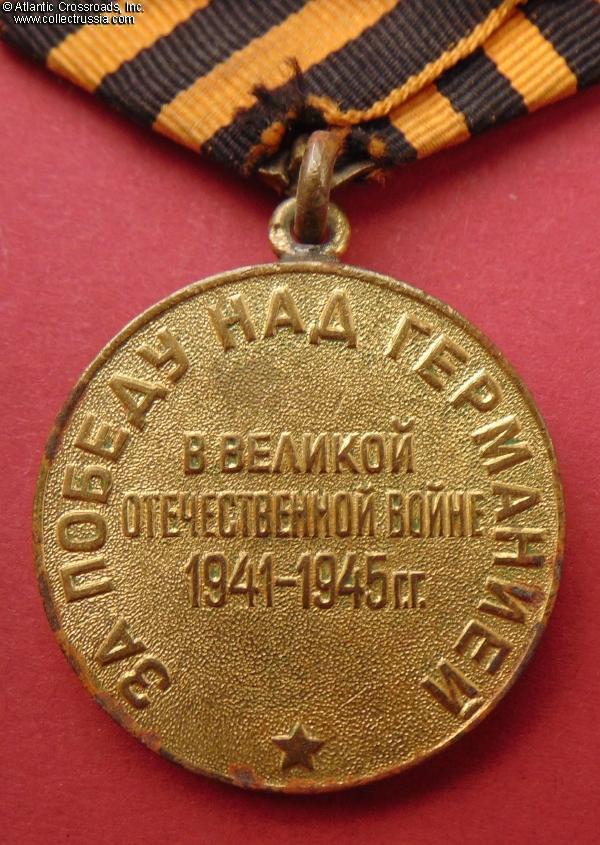
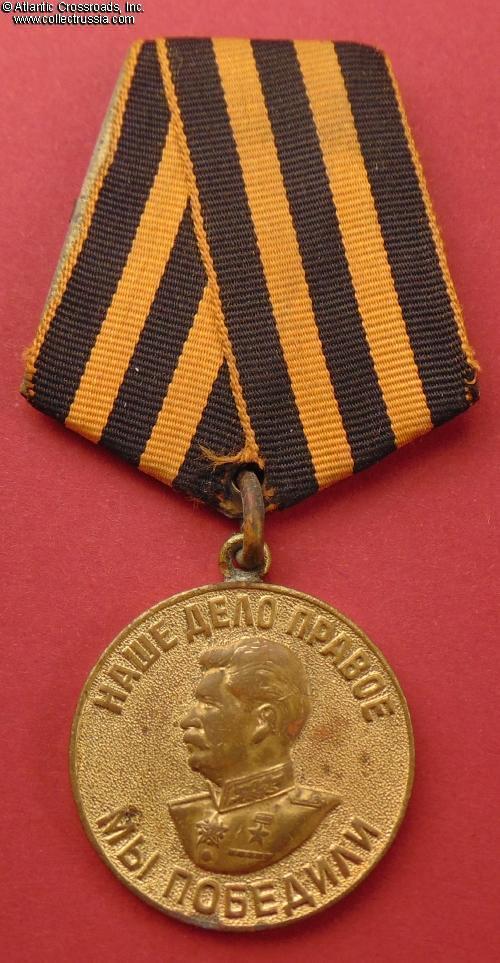
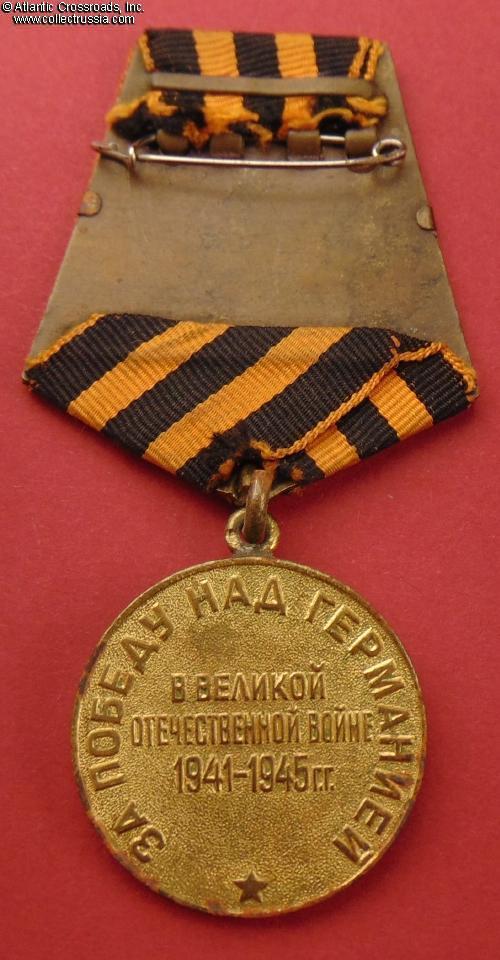
Medal for the Victory over Germany, Variation 1. In brass; measures 36.9 mm in height incl. eyelet, 32.1 mm in width. Features a separate eyelet soldered to the medallion. In very fine to excellent condition. The medallion is free of noticeable scratches, dings or edge bumps. There is only a very mild wear to the highest points of the bas-relief portrait; its details are very well-preserved. The reverse has just a few minuscule contact marks that are practically invisible to the naked eye, otherwise pristine. There are minor blemishes along the edge on both sides and slight tarnish but no excessive oxidation. The original "gilt" mint luster is nicely preserved and bright in recessed areas on both sides. The medal comes on WW2 era suspension, a double-layer model in brass with self-locking pin. The beautifully preserved, clean ribbon is old, likely of the period. The connecting link is a replacement. A very attractive example overall.
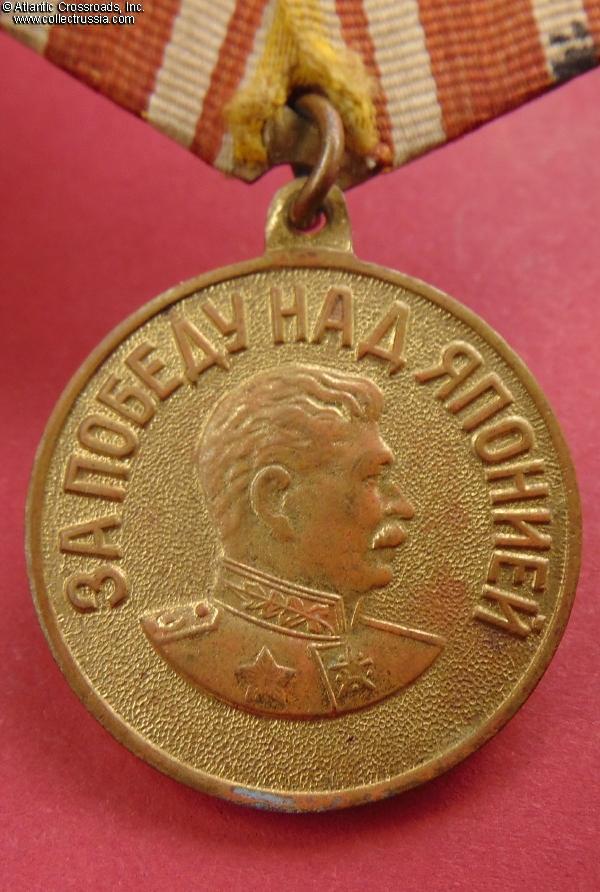
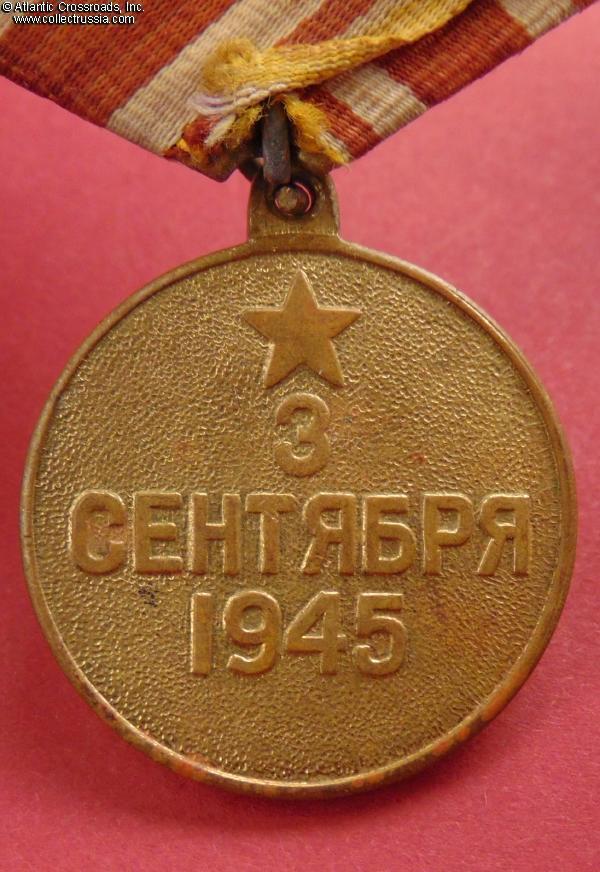
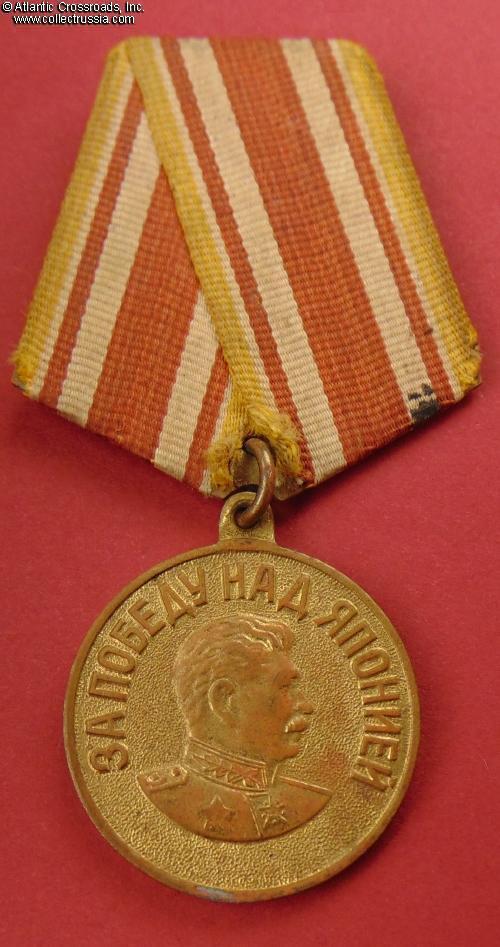
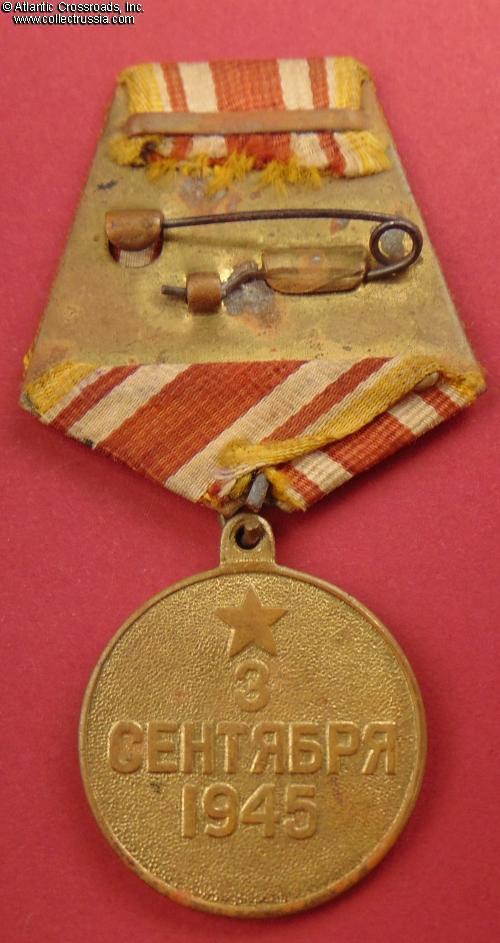
Medal for Victory over Japan, Variation 2. In brass; measures 37.2 mm in height incl. eyelet, 32.1 mm wide. Features a U-shaped eyelet. In excellent condition. There is only a tiny amount of wear to the high points of the bas-relief portrait; its details are well- preserved and exceptionally crisp. Both sides are otherwise perfect and have only microscopic contact marks that can be found under a 10x magnification. The brass exhibits light tarnish that adds character, while a good amount of the original "gilt" mint luster is present in recessed areas on both sides. Comes on original late-1940s suspension device, a single-layer model in brass. The old, possibly original ribbon shows wear at the lower edge but is still sound and clean. The connecting link appears to be of the period. Overall, a very attractive example of the Victory over Japan Medal.
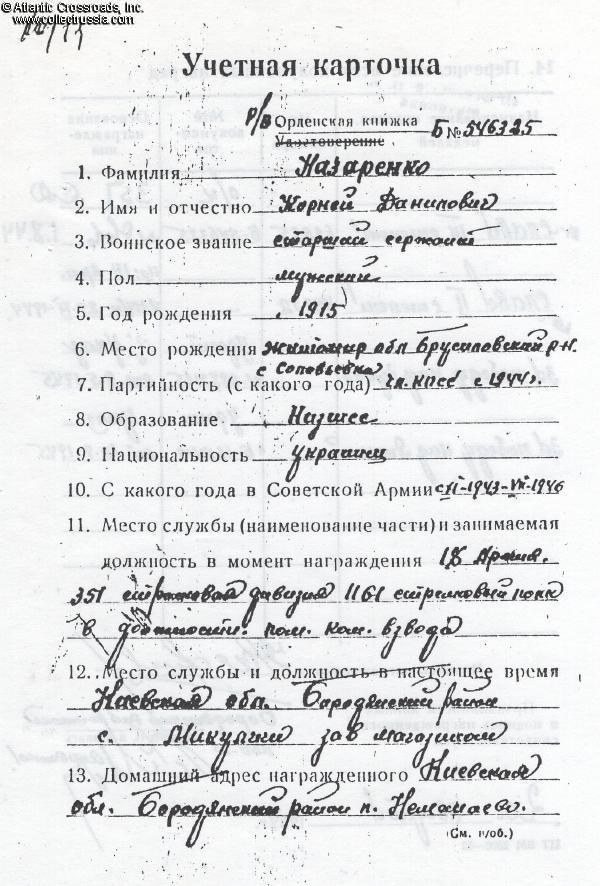
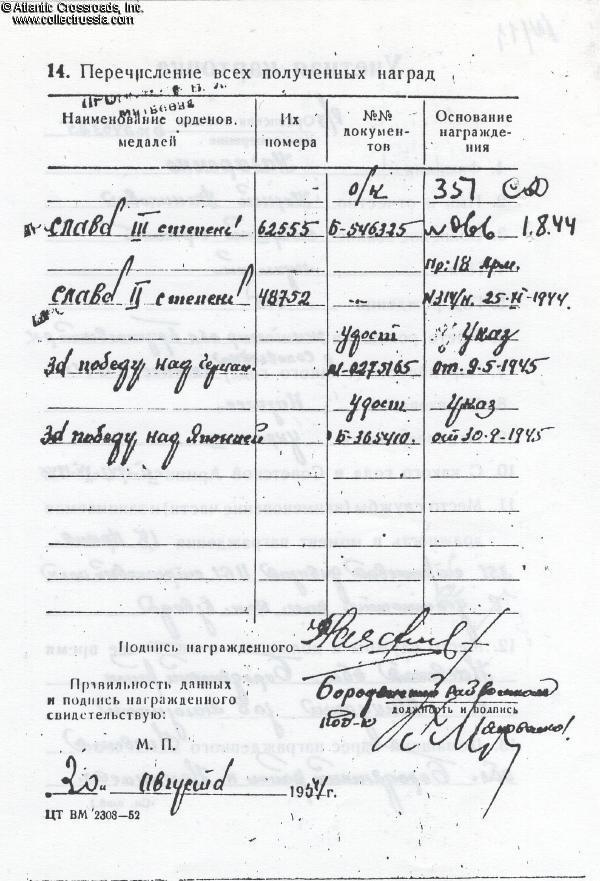
(Please note: the group does not include award certificates for the two victory medals, but both medals are shown on the recipient's award record card.)
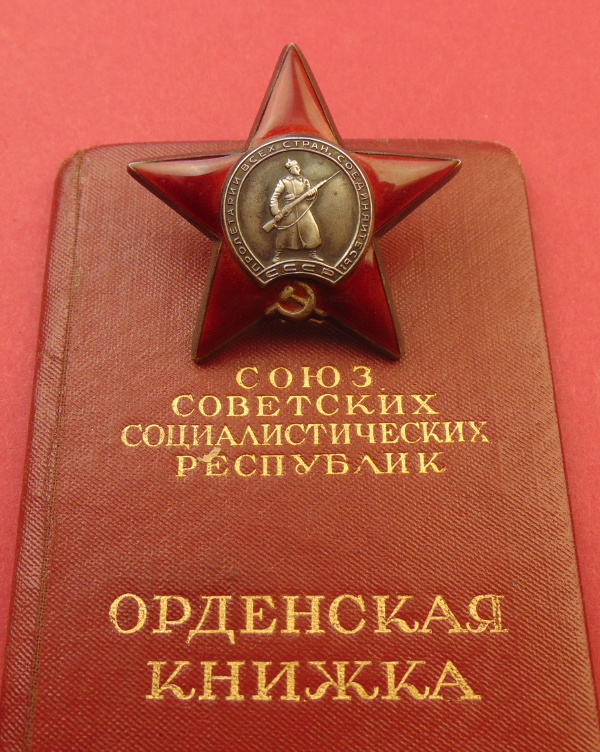
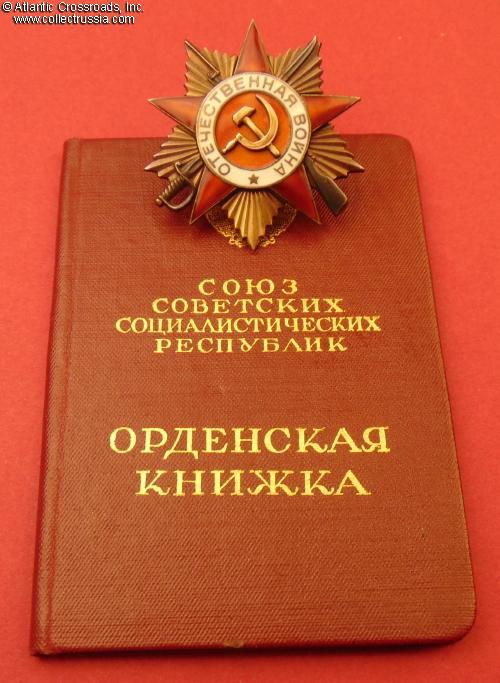
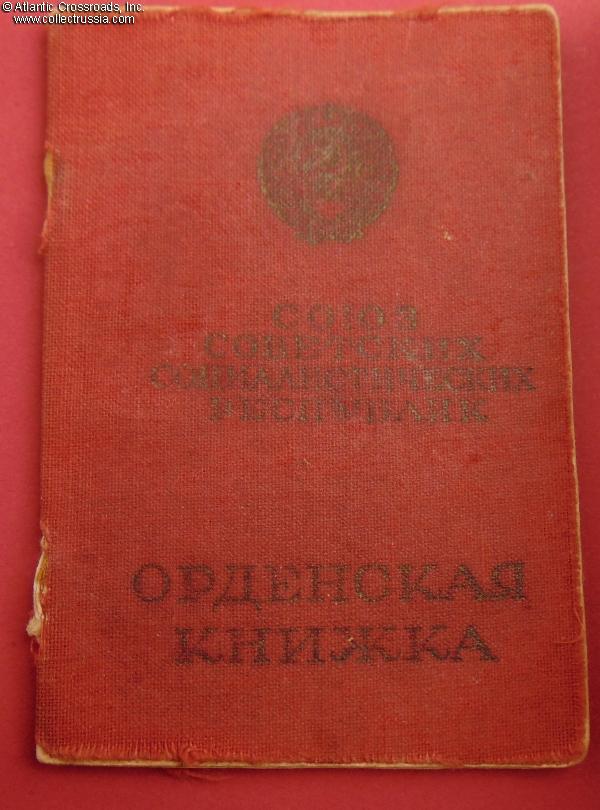
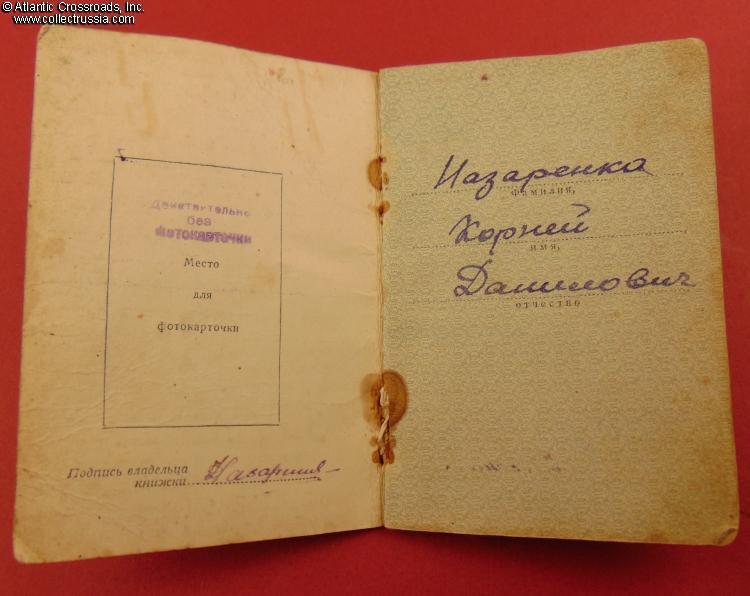
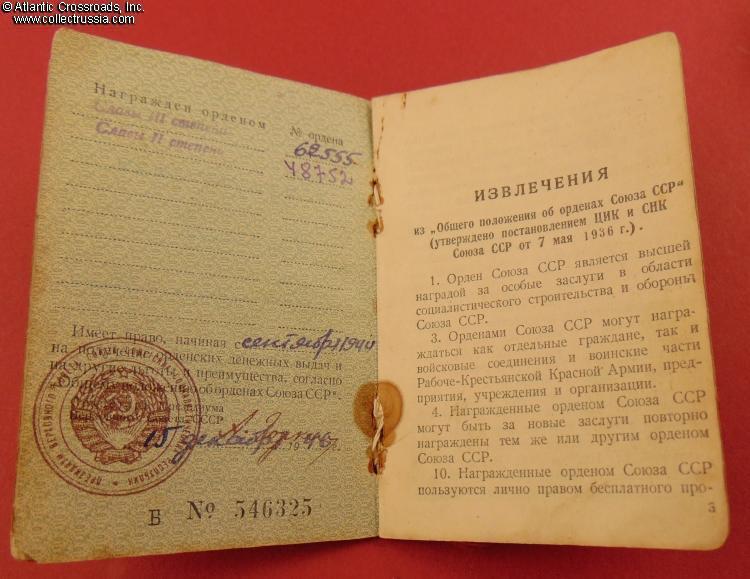
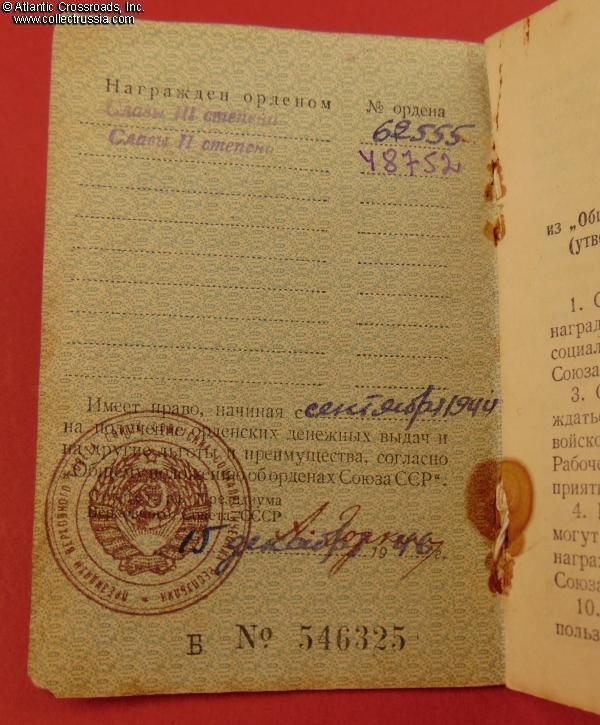
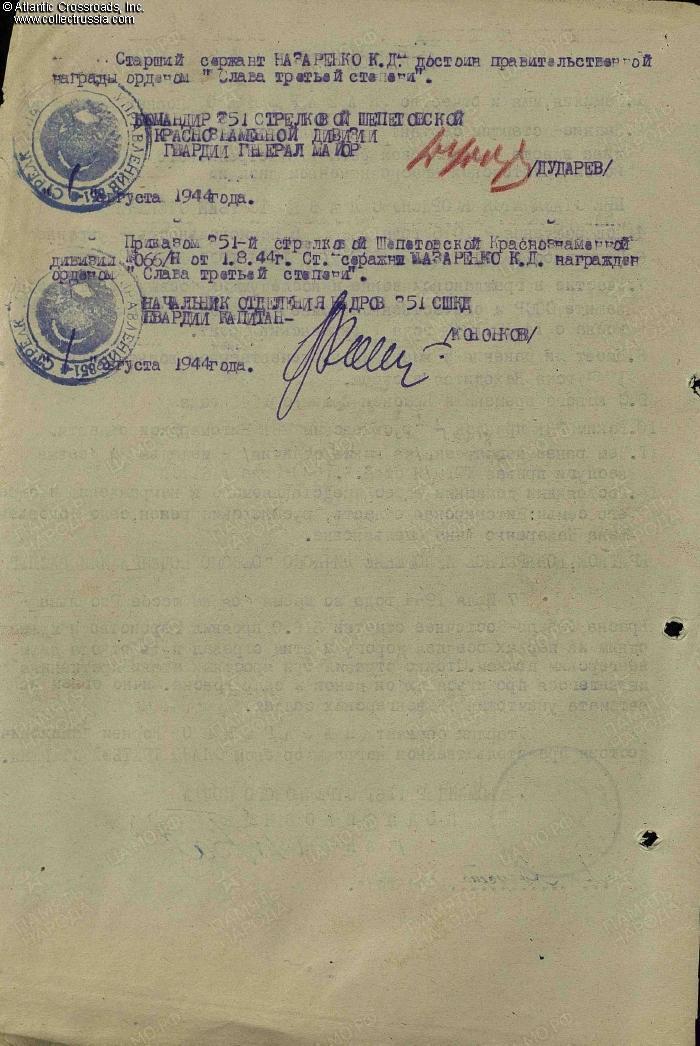
Order Booklet, Series B #546325, issued on 15 December 1946. The group is complete: the document contains only the entries for the two Orders of Glory, and according to the archival information, the recipient had no other numbered wartime decorations. The first of the two, Glory 3rd cl. #62555, was entered when the document was filled-out; the Order of Glory 2nd cl. was added at a later date as was customary. Note that both award serial numbers as well as the serial number of the document are confirmed by the archival records included with the group (see below). The date for the start of special privileges is 1 September 1944, corresponding with an August 1944 date of the award decree for the Order of Glory 3rd cl.
The document is in very good condition. There is a moderate wear to the oilcloth of the cover, mostly to the edges. The binding staples have been replaced with sewn thread ties. The internal pages are mostly clean; all the printed, handwritten, and stamped entries are clear and perfectly legible.
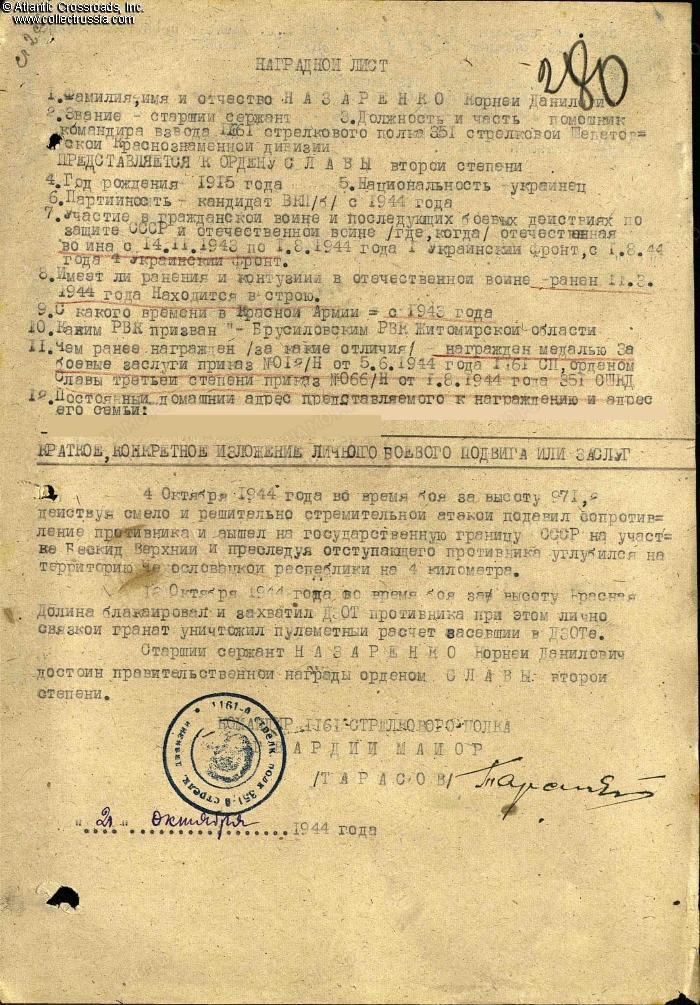
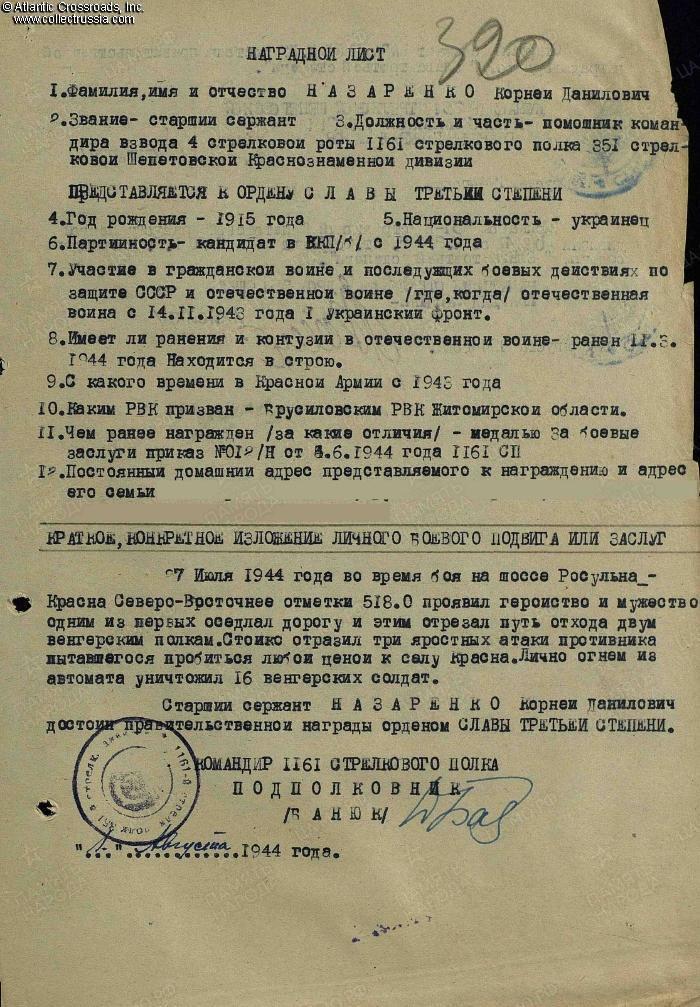
Korney Nazarenko was born in 1915 in a village in the Zhitomir region in Western Ukraine, then part of the Russian Empire. His award commendation for the Order of Glory 3rd cl. states that he was drafted into the Red Army on 14 November 1943 by his local District Military Commissariat in Brusilov, Zhitomir Region. Keeping in mind that Zhitomir was liberated from the Nazis twice in a very short period of time, it appears that Nazarenko was conscripted, or volunteered, within days after the first liberation which happened on 12 November 1943 during the Kiev offensive. The German counteroffensive re-captured the city of Zhitomir and town of Brusilov a few days later, and it was only when General Vatutin's 1st Ukrainian Front launched the Zhitomir-Berdichev offensive on Christmas Eve as part of the massive Dnieper-Carpathian offensive, that Zhitomir came under the Soviet control for good on the eve of 1944.
Within seven months after joining the Red Army, Nazarenko was promoted to Senior Sergeant, obviously an evidence of his uncommon abilities as a soldier. As of the end of July 1944, he served as deputy platoon commander with the 1161st Rifle Regiment, 351st Rifle Division, 18th Army, 1st Ukrainian Front. At the time, his army was engaged on the southernmost flank of the Lvov-Sandomierz offensive. This massive and brilliant Soviet operation in Galicia started in mid-July and came on the heels of the major Soviet success against the Army Group Center during the previous weeks in the Operation Bagration. One of the series of Soviet offensives on the southern flank, it ultimately succeeded in pushing the front westward some 250 miles, crushing the Axis Army Group Northern Ukraine, and establishing a strategic bridgehead on the Vistula River in Poland.
On 27 July 1944, Nazarenko's regiment was fighting for possession of a stretch of highway between Krasna and Rosilna, two villages about 25 miles from each other in the Ivano-Frankovsk Region in southwestern Ukraine just southwest of Stanislav (formerly the Polish city of Stanisławów, it was renamed Stalinslav after the Soviet occupation of eastern Poland in 1939, renamed Ivano-Frankovsk after WW2, and is now known by its Ukrainian name Ivano-Frankivsk). Nazarenko distinguished himself by being one of the first to block the road and cut off the way of retreat for two Hungarian regiments. He repelled three desperate attacks of the Hungarians trying to break through the roadblock and personally killed 16 enemy soldiers. For his actions, his regiment commander recommended him for the Order of Glory 3rd cl. which was awarded to Nazarenko on 1 August 1944.
During the same month, the 18th Army was resubordinated to the 4th Ukrainian Front. Starting from the following September, Nazarenko's 351st Division took part in heavy fighting in the Carpathian Mountains driving German Army Group Heinrici west-southwest across the range of Beskids, an extremely difficult mountainous terrain heavily defended by the Germans. On 4 October 1944, Nazarenko distinguished himself by suppressing the enemy defenses, reaching the USSR state border near Beskid Verkhniy and pursuing the enemy further, four kilometers deep into the territory of Czechoslovakia. On 12 October, Nazarenko's bravery got noted again during the fight for the Krasnaya Dolina Height when he personally seized an enemy pillbox and killed its crew lobbing a bundle of hand grenades into the emplacement.
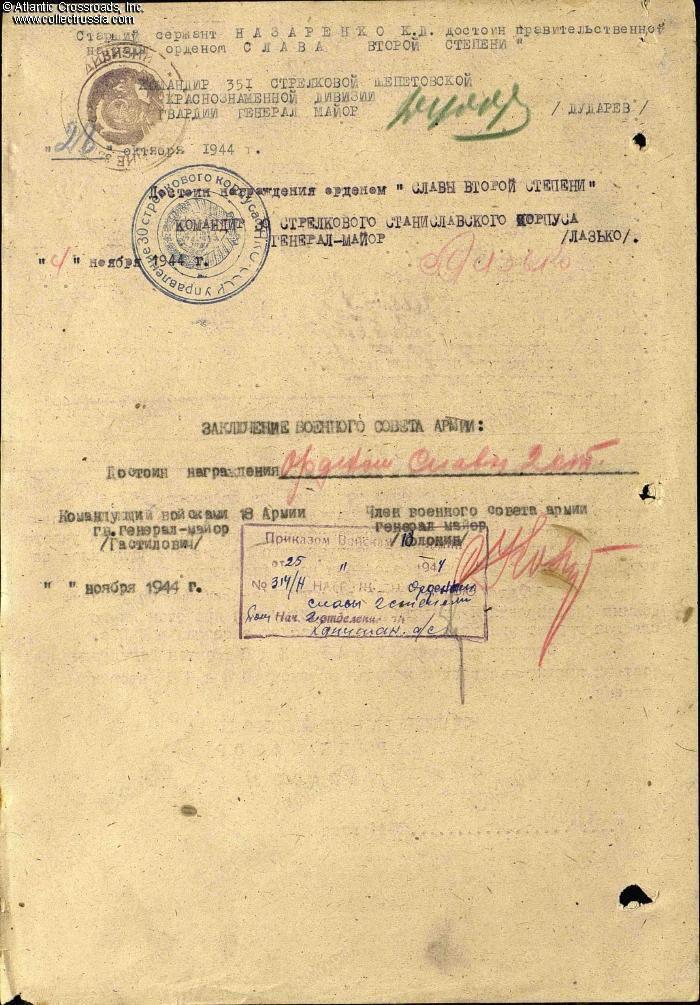
For his courage under fire and outstanding performance, Sr. Sgt. Nazarenko was recommended for the Order of Glory 2nd cl. which was bestowed upon him on 25 November 1944. This was his second and last wartime high decoration. Note that although the award date is very early for the Order of Glory, 2nd cl., the serial number of the decoration actually issued to Nazarenko is extremely high. This clearly indicates a case of what Russians call "the award found its hero": a not-so-rare occurrence when a wartime award decree was lost due to a bureaucratic boondoggle, found years later, and eventually resulted in the decoration physically issued to its intended recipient long after the war. This also explains why the Order of Glory 2nd cl was not initially recorded in the orders booklet when the document was filled-out in December 1946 but was instead added later.
Nazarenko's combat service did not end with victory in Europe: he was one of the hundreds of thousands of Soviet soldiers redeployed to the Far East following the German surrender. In August 1945, he took part in the Soviet Blitz against Japan and was subsequently awarded with the Medal for Victory over Japan. He was released from active duty almost a year later, in July 1946. As of August 1954, when his award record card was filled out, he lived in a village in Kiev Region and worked as manager of a country store.
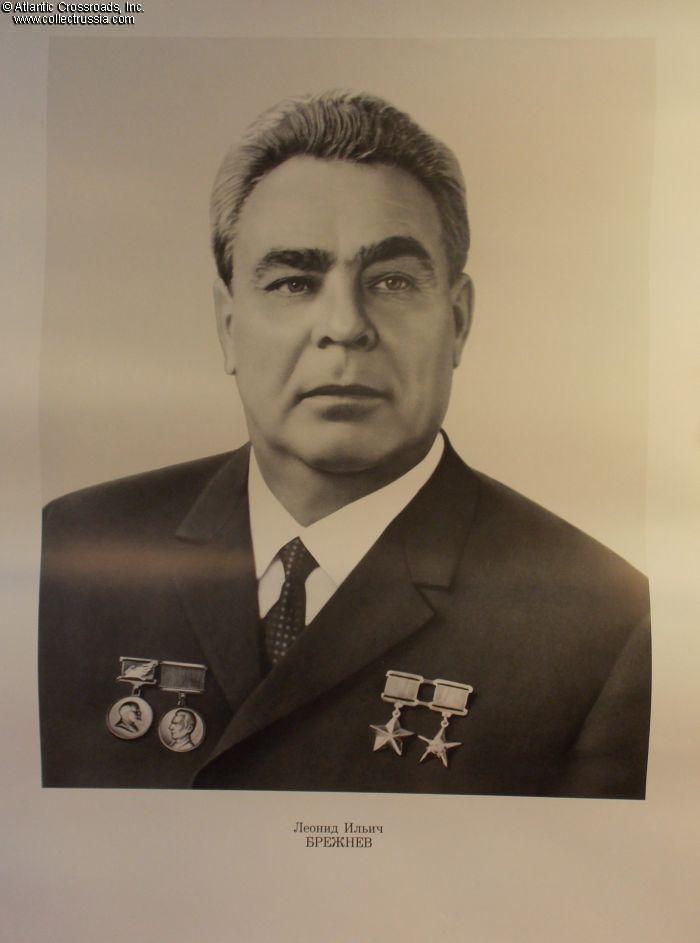
As a historical footnote, the 18th Army to which Nazarenko's regiment and division were subordinated during the last year of the Patriotic War is quite famous. The reason is not only its military achievements in WW2, of which there are many, but also because its chief political officer from 1 April 1943 until June 1945 was none other than Leonid Brezhnev, the future Soviet premier. Among some of the early battles the 18th Army fought was the drawn-out fight for the Malaya Zemlya ("Small Land") beachhead near Novorossiysk. Brezhnev visited this tenuous position several times during its defense. Much later, this used by Soviet historians to immortalize his contribution to the Patriotic War by blowing the significance of the operation out of all proportion. The book Malaya Zemlya, ostensibly written by Brezhnev but in fact, ghostwritten for him, became a required reading for millions of Soviet school students during the last years of Brezhnev's reign.
Although Nazarenko joined the 18th Army long after the Novorossiysk landing, Brezhnev was still the chief of the army's political department. It is highly likely that Nazarenko saw Brezhnev on many occasions in 1944 - early 1945. Quite possibly, the two have met - especially in view of the fact that Nazarenko was among the early recipients of the Order of Glory, 3rd cl. It would not even be a stretch of imagination that Brezhnev was present at Nazarenko's award ceremony!
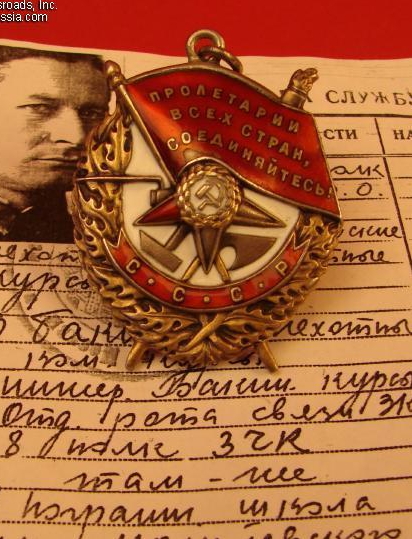
Research Materials: b/w copy of the award record card and award commendations for both Orders of Glory, includes English translation
of both award commendations.
$2,500.00 Add to cart