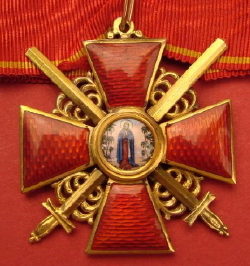
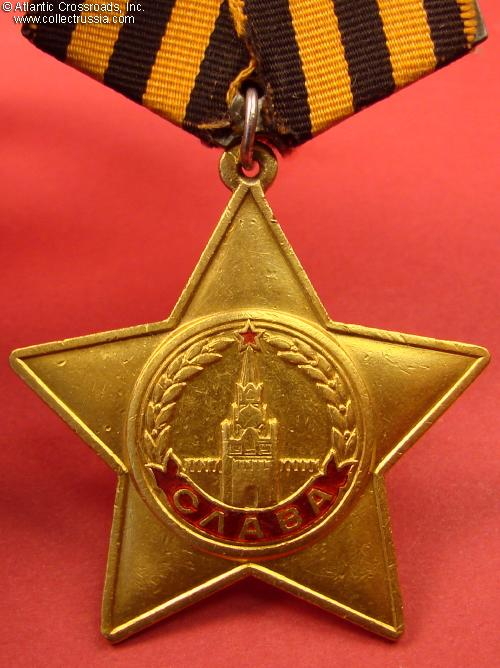
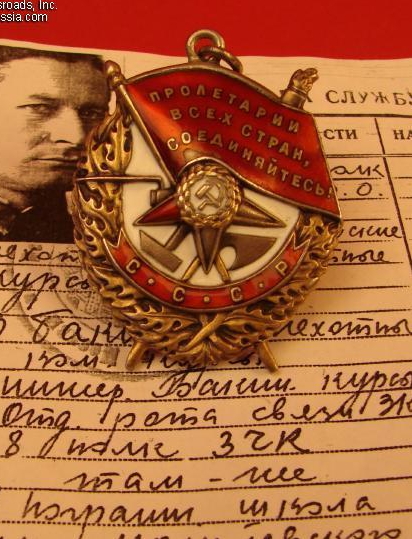
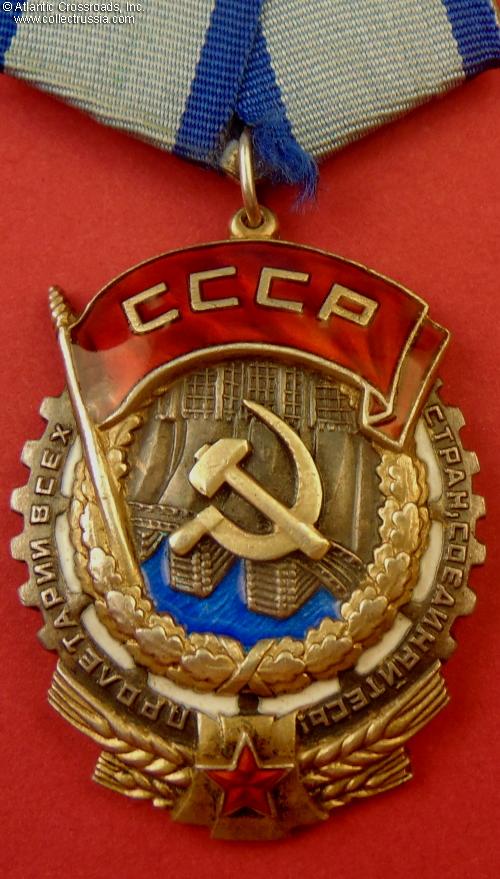



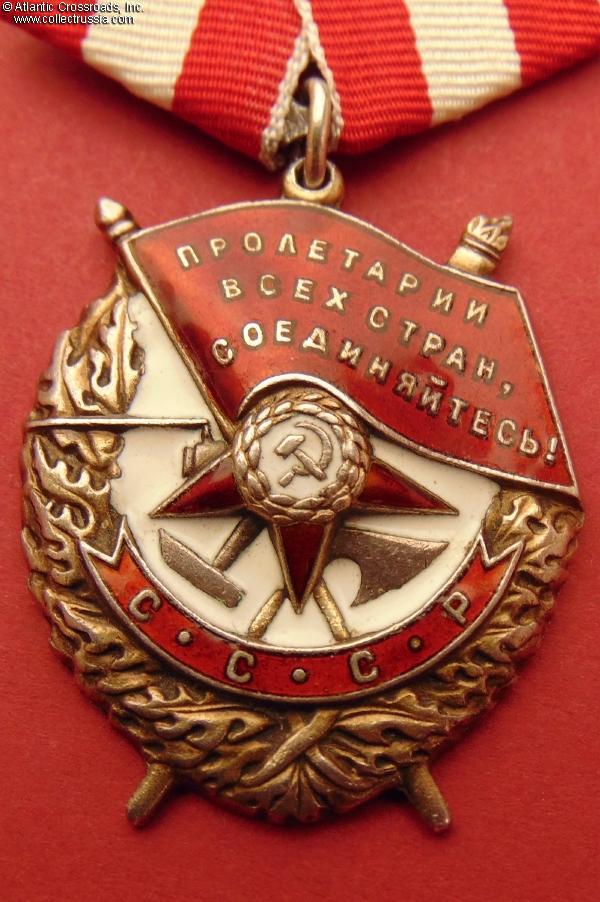
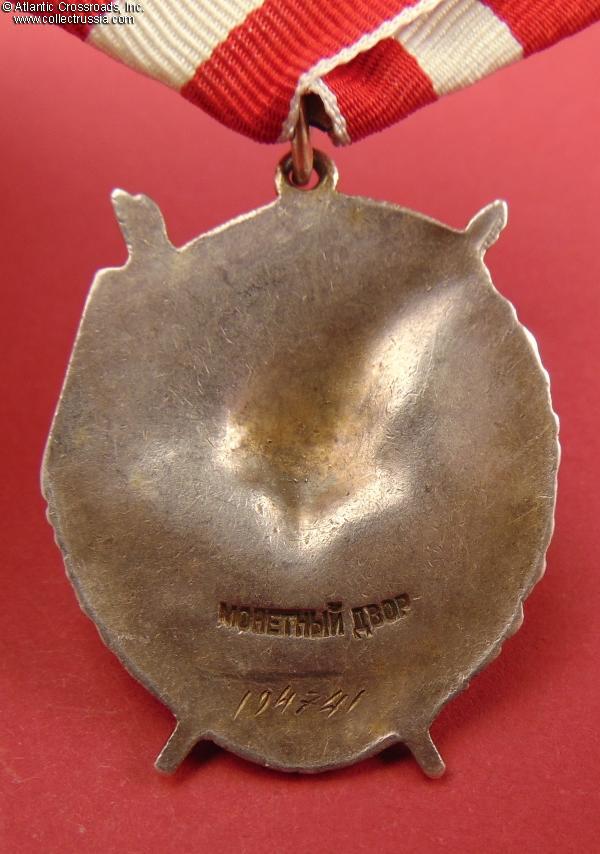
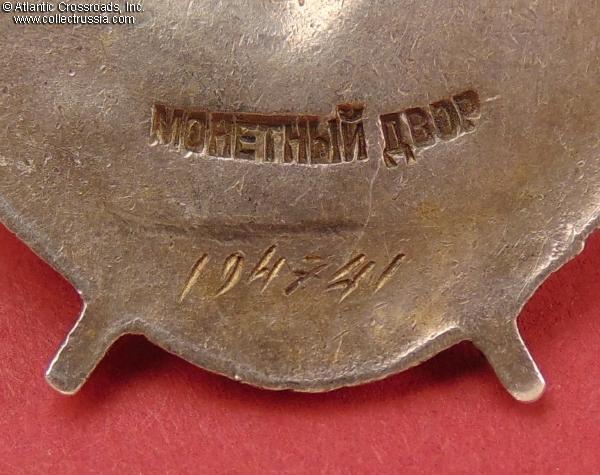
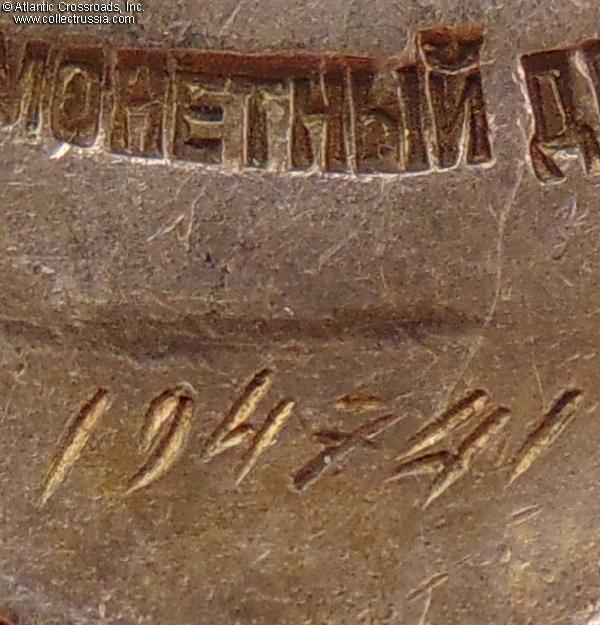
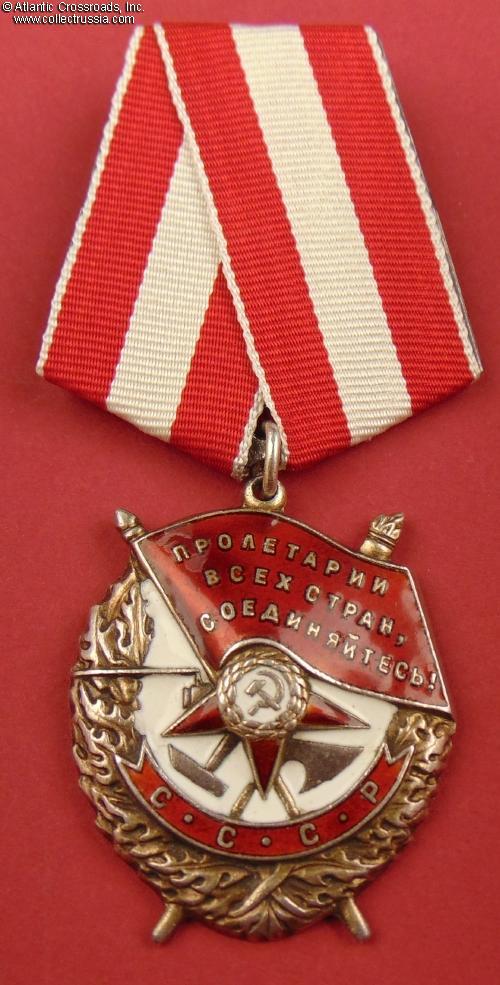
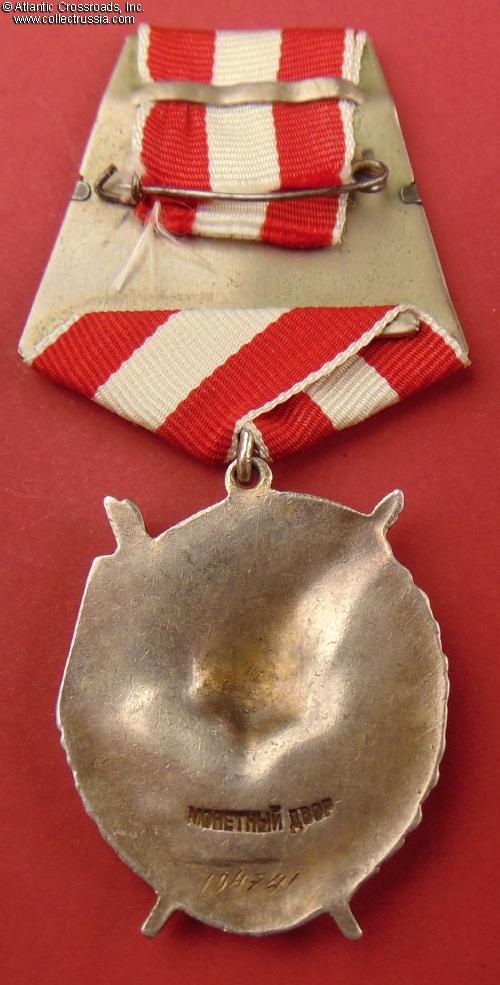
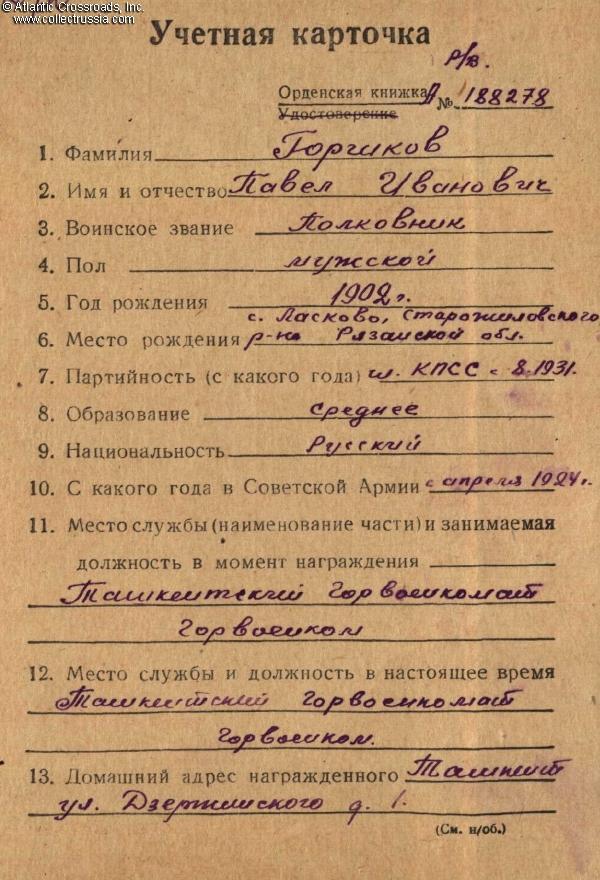
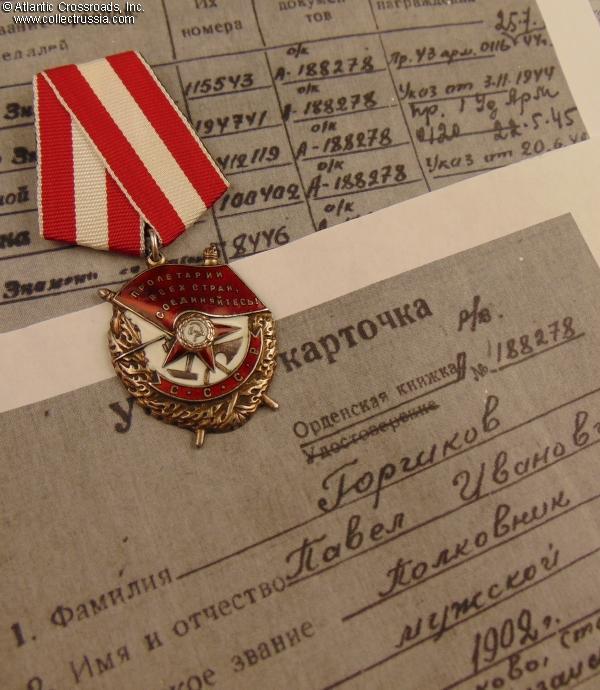
Order of the Red Banner, Type 4, Variation 2, Sub-variation 1 (Strekalov classification), #194741, awarded on 3 November 1944 to Colonel Pavel Gorshkov (Павел Иванович Горшков), Commander of the 1192nd Rifle Regiment, 357th Rifle Division, 1st Shock Army, 3rd Baltic Front.
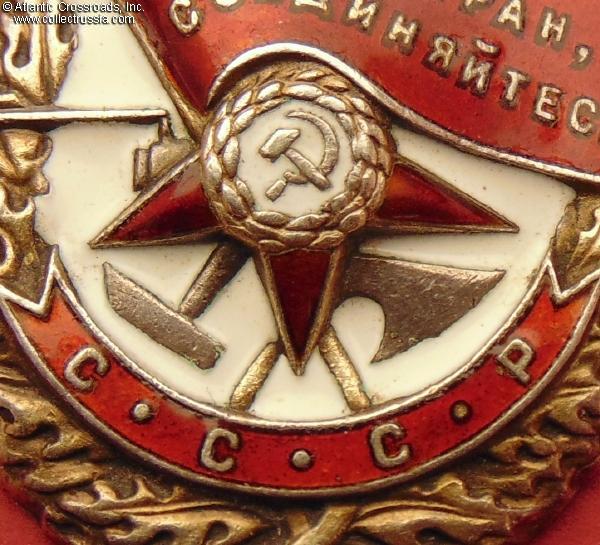
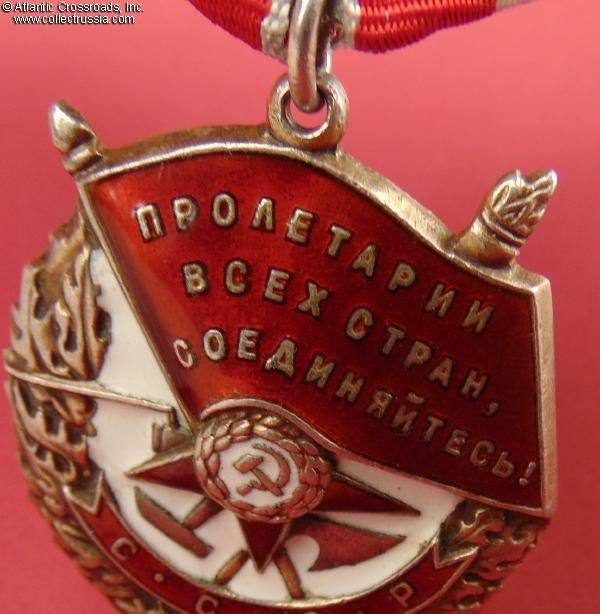
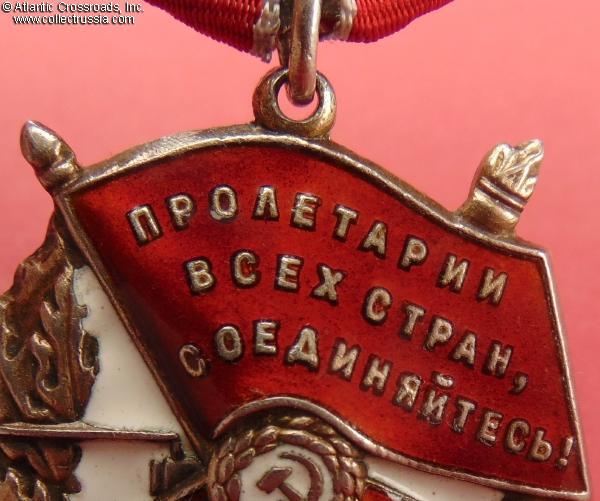
The medallion is in silver gilt and enamels; 45.7 mm tall (incl. eyelet), 37.5 mm wide; weighs 27.3 g not including the suspension and connecting link. Manufactured in 1945 at the Moscow Mint (note that the award decree probably came earlier than the date of manufacture e.g. the order could be "issued" before it was manufactured and actually delivered to the recipient.) Features a curved-up mint mark in small font, with a curved dash above the last character in the word "Monetnyi". This is a very uncommon variety: its known serial number range is from 189839 through 197976. /Dur
The medallion is in silver gilt and enamels; 45.7 mm tall (incl. eyelet), 37.5 mm wide; weighs 27.3 g not including the suspension and connecting link. Manufactured in 1945 at the Moscow Mint (note that the award decree probably came earlier than the date of manufacture e.g. the order could be "issued" before it was manufactured and actually delivered to the recipient.) Features a curved-up mint mark in small font, with a curved dash above the last character in the word "Monetnyi". This is a very uncommon variety: its known serial number range is from 189839 through 197976. /Durov & Strekalov, The Order of the Red Banner, p. 132/.
In very fine to excellent condition. The enamel appears almost perfect to the unaided eye and retains a beautiful luster everywhere; there are only a few minuscule surface flakes to the red enamel, all of them nearly unnoticeable without magnification. Much of the original gilt is present. There is a very attractive even toning to the silver on the reverse. Comes on an original WW2 suspension, a two-layer model in steel with a self-locking pin. The ribbon is new (from old unused Soviet stock). The connecting link appears to be original, and its ends are joined with solder.
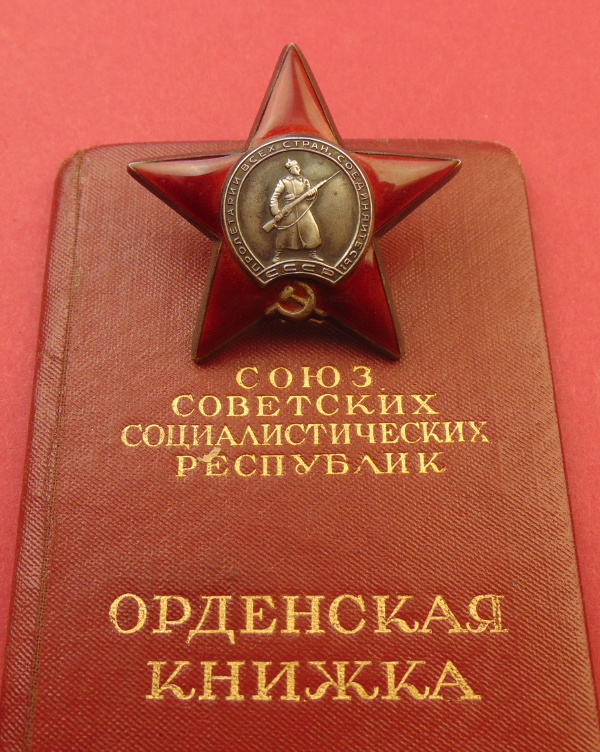
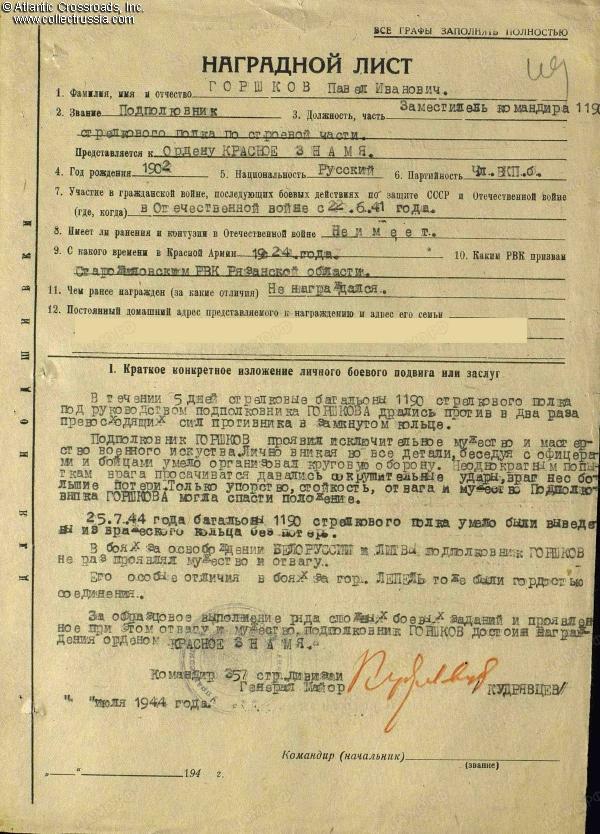
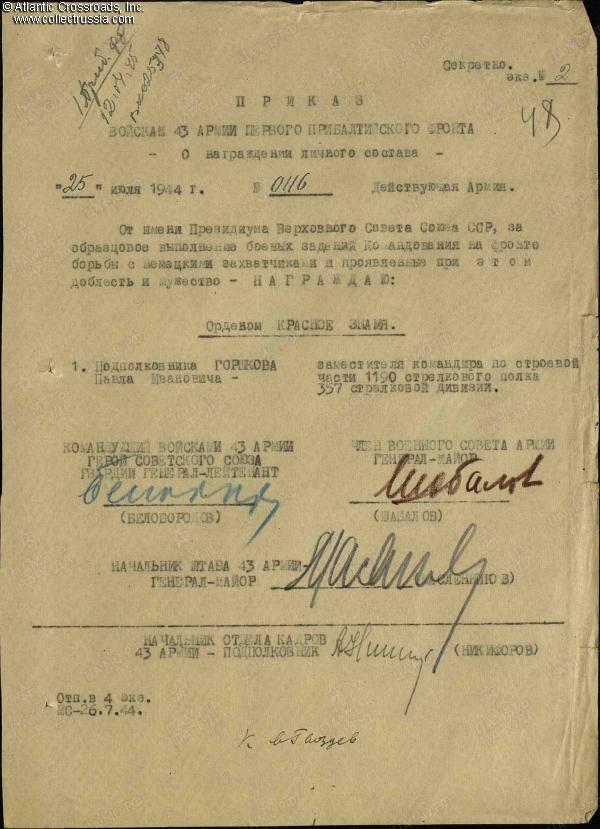
Pavel Gorshkov was born in 1902 in a village in Ryazan Province of the Russian Empire, about 140 miles southeast of Moscow. In 1924, he joined the Red Army and eventually became a cadre officer. He was on the front of the Patriotic War since day one, 22 June 1941. In July 1944 he had the rank of Lieutenant Colonel and served as Deputy Commander of the 1190th Rifle Regiment, 357th Rifle Division, 43rd Army, 1st Baltic Front. Having liberated the Belorussian city of Lepel, the army was advancing in northwestern direction, now through Lithuania. On 20th July, Gorshkov's rifle battalion was encircled and fought for five days and nights repelling attack after attack. On 25 July, Gorshkov succeeded not only in extricating his troops from the trap, but also in doing so without losing any lives. For that feat and for distinguished performance during the fighting to liberate Lepel, Gorshkov was recommended for the Order of the Red Banner which was awarded to him on 25 July 1944 (#115543).
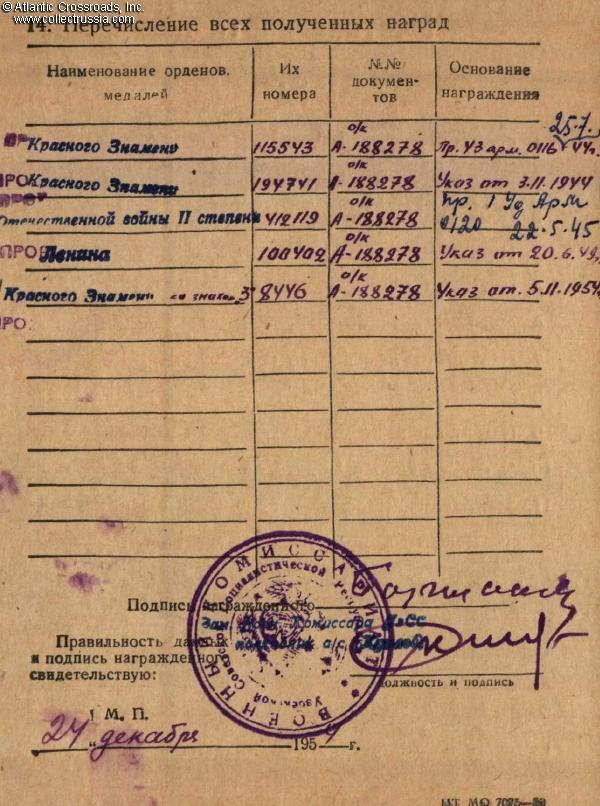
This decoration was followed by another Order of the Red Banner, #194741, awarded in November 1944 for 20 years of uninterrupted service in the military. Note that although it was Gorshkov's second Order of the Red Banner, the decoration he got was the "plain" version rather than the Second Award with a plaque and numeral 2- as was often the case during the war and early post-war years.
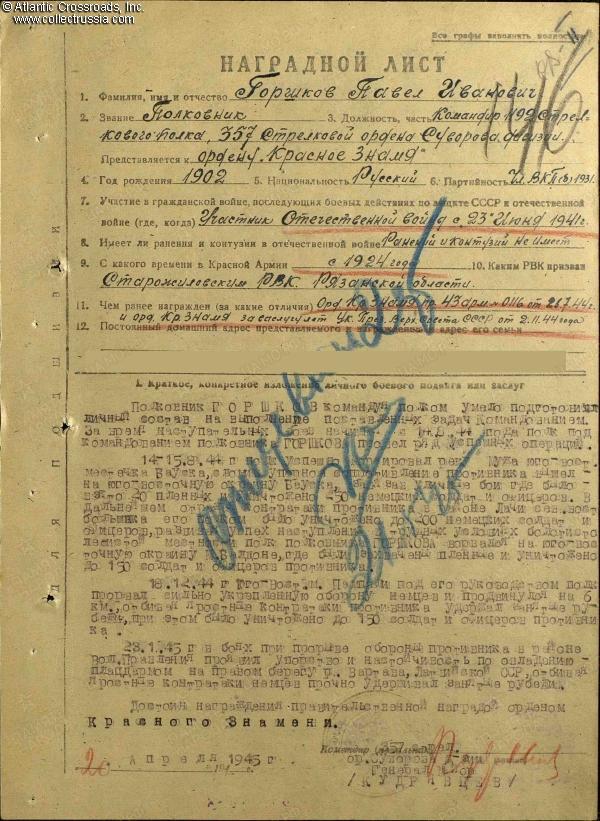
By August 1944 Gorshkov had been promoted to Colonel and put in command of the 1192nd Rifle Regiment of the 357th Rifle Division which had been resubordinated to the 1st Shock Army, 3rd Baltic Front. At the time, the 1st Shock Army was on the offensive in Latvia. On 14 August, Gorshkov's 1192nd Regiment was on the southern bank of the Musa River on the outskirts of the town of Bauska, about 40 miles south of Riga. After a successful forced crossing of the river to the southeast of Bauska, the regiment engaged in house-to-house fighting, killing 250 enemy soldiers and capturing 20. Continuing the offensive momentum and moving toward Riga, the 1192nd entered the village of Baldone and cleared it of the enemy, killing 150 soldiers and taking some more POWs.
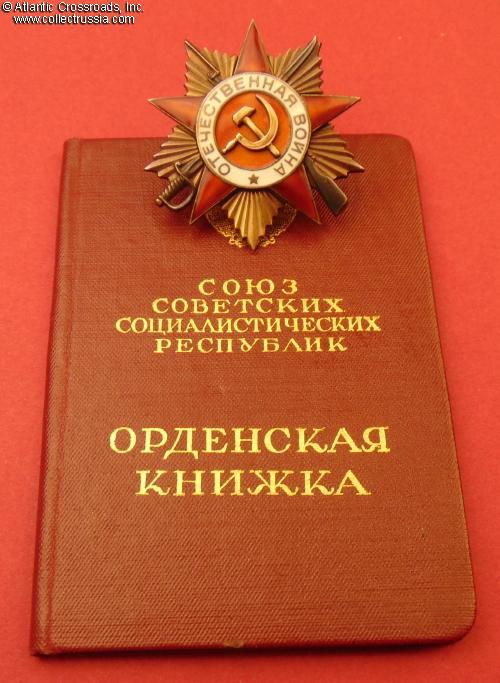
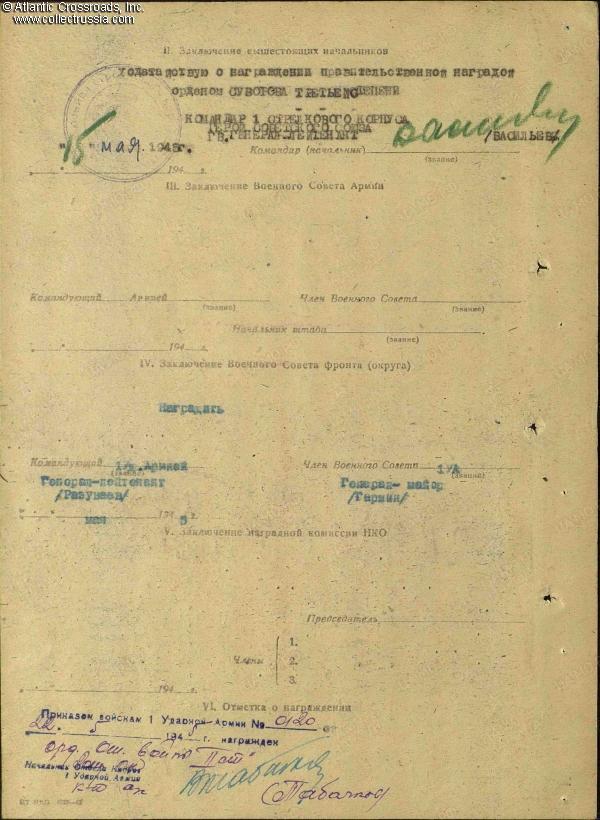
At the end of January 1945, Gorshkov's regiment was pushing against fierce resistance from the 4th SS "Nederland" Mechanized Brigade about 40 miles southeast of Liepaja. The 1192nd distinguished itself by capturing and holding a bridgehead on the right bank of the Barta River. For Gorshkov's excellent leadership, Commander of the 357th Rifle Division Maj. Gen. Kudryavtsev recommended him for the Order of the Red Banner. Commander of the 1st Rifle Corps changed the recommended award to the Order of Suvorov 3rd cl.; however, further up the chain of command, the Commander of the 1st Shock Army inexplicably downgraded it to the Order of the Patriotic War 2nd cl. which was awarded to Gorshkov on 22 May 1945.
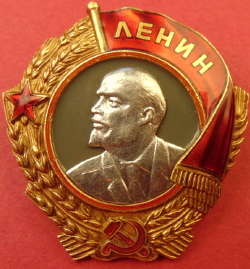
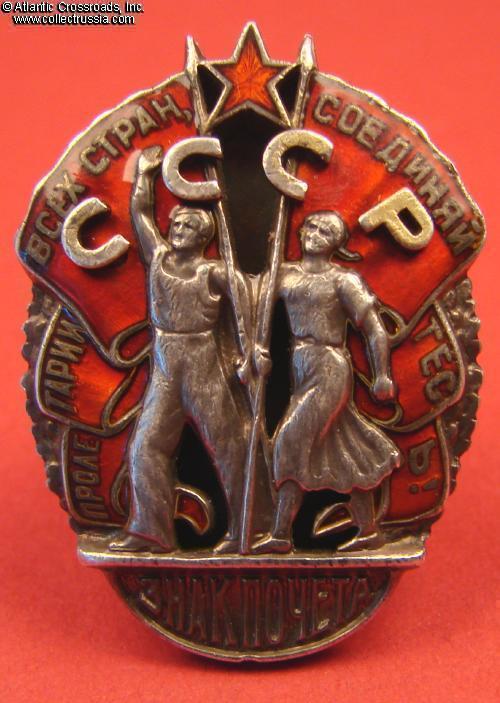
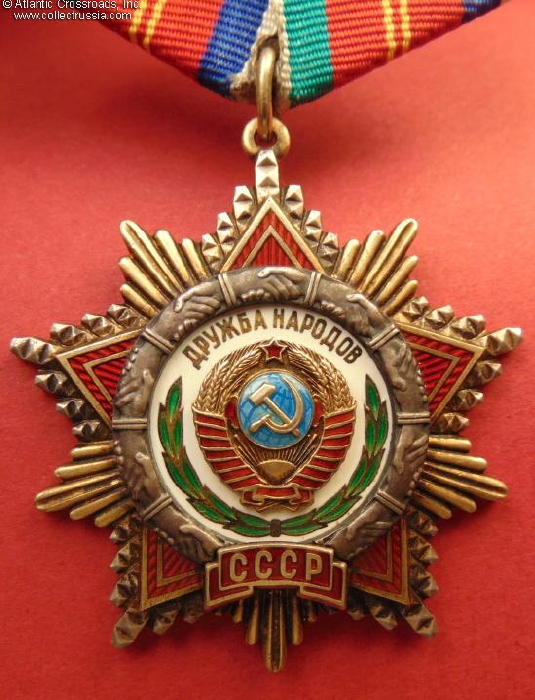
After the war, Gorshkov received two more decorations for length of service: Order of Lenin (#100402) in 1949 and Order of the Red Banner, 3rd Award (#8446) in 1954, the latter for 30 years of uninterrupted service. As of December 1954, when his award record card was filled in, he was still on active duty in the military and held the high post of the Military Commissar of the city of Tashkent, the capital of Soviet Uzbekistan.
Research Materials: b/w photocopy of the award record card, award commendation and decree for the July 1944 Order of the Red Banner,
and award commendation for the Order of the Patriotic War 2nd cl.
$475.00 Add to cart